Your Ioniq 5 still wakes, but the dash is telling you the 12-volt battery voltage is low. That warning is not an empty drive pack, and it is not a no-start yet. In Chicago, it often shows up after a lake-effect night on the street, before the car fully dies.
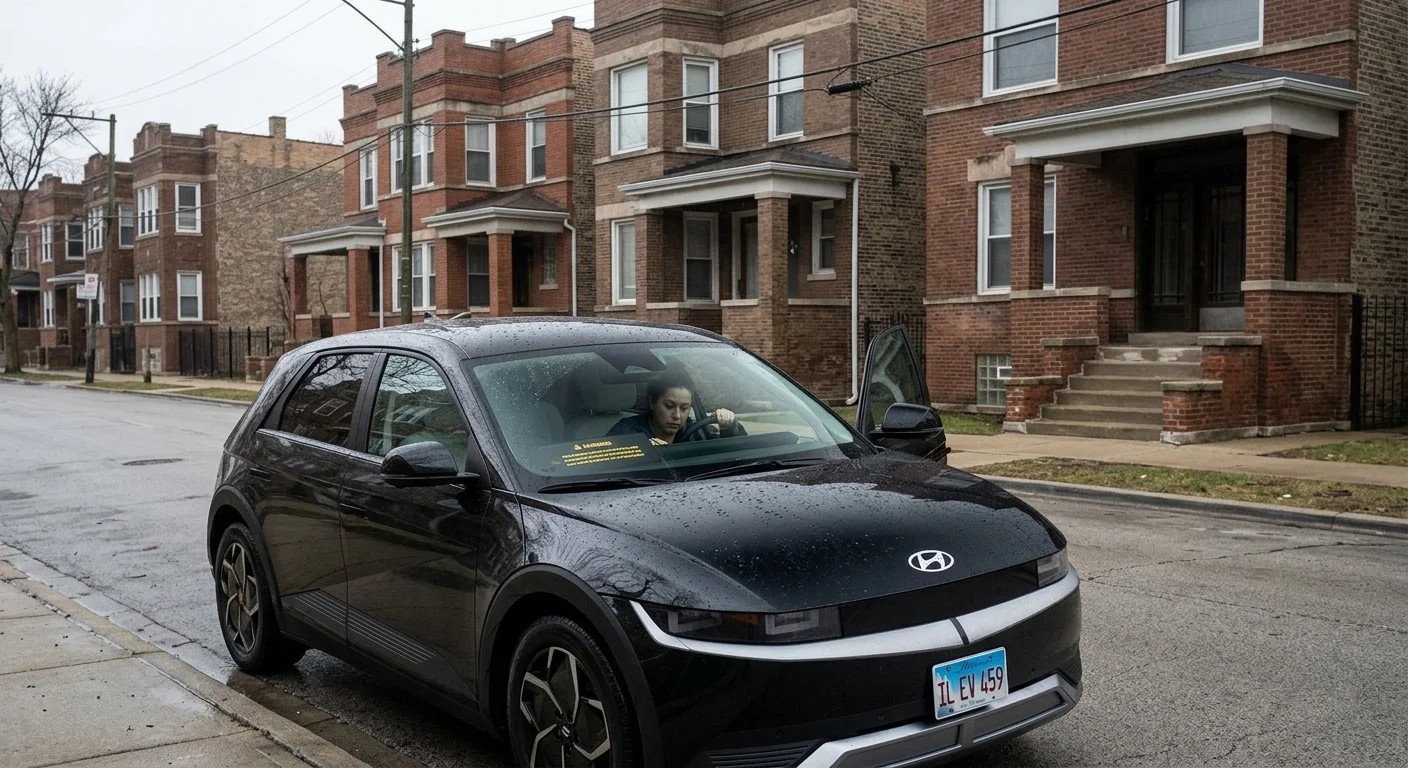
What a low 12V voltage warning means on an Ioniq 5
A Hyundai Ioniq 5 12V battery voltage low warning is about the small auxiliary battery, not the big pack that moves the car. The U.S. Department of Energy describes electric vehicles as high-voltage machines with separate low-voltage systems for lights, locks, and computers. The Ioniq 5 follows that split. The traction battery drives the motors. The 12-volt battery wakes the screens, the charge door, the fob response, and the computers that let the car go into Ready.
When voltage on that 12-volt side sags, the car can still look alive. Interior lights come on, then flicker. The cluster boots, then throws a 12V warning. Bluelink or the Hyundai app may still ping, or it may drop. You can sit in a permit space off Milwaukee Avenue with miles showing on the range bar and still be one more cold night from a car that will not turn on.
This page is for that in-between state. The car is not fully dead. You are reading a voltage-low message, not staring at a blank cabin. If the Ioniq 5 already refuses to wake, use the separate Ioniq 5 no-start 12V checks instead of repeating them here.
Exact cluster wording, sensor names, and a published voltage cutoff could not be confirmed from a citable Hyundai owner’s manual. Do not treat a number you saw on a forum as Hyundai’s rule. Open the owner’s manual for your model year, or ask a Chicago-area Hyundai dealer what that warning is specified to mean on your car.
A 12-volt battery can also look “fine” on a resting reading and still fail under load. Computers, heaters, and door motors pull hard when you first wake the car. A meter sitting at a round 12 volts does not prove the battery can hold that load. A dealer or independent shop can load-test it. Charge Pro CHI does not test batteries and does not perform that work.
Why Chicago cold and short trips drain the 12V
Chicago is a hard place for a 12-volt battery that never gets a long, warm drive. A lot of Ioniq 5s here live at the curb, not in a heated garage. Cook County housing stock is old: 68.6% of Chicago housing was built before 1980. Brick two-flats in Logan Square, Humboldt Park, Pilsen, and Bridgeport often have unheated rear stairs and open alleys. The car sits in that air all night. Lake-effect wind off the water makes Rogers Park, Edgewater, and the inner North Shore colder than a map suggests.
Short errand cycles make it worse. School drop-off, a Jewel run, a hop down the Kennedy or the Dan Ryan, then back to a permit block. The traction pack barely works. The 12-volt side still has to boot the computers every time you unlock. If you never plug in at home, the car is also deciding, on its own schedule, when to borrow energy from the big pack to support the small one. That logic is Hyundai’s. A published voltage where it kicks in could not be confirmed here. Treat it as unconfirmed, and check the manual or a dealer rather than guessing.
Street parking adds drain you do not see in a suburban garage. Remote climate, app checks, and a fob in a coat pocket that keeps talking to the car all nibble at the 12-volt battery. After a stretch of single-digit nights, the warning can appear on a Thursday morning even though the range bar still looks healthy.
The same pattern shows up in Cicero and Berwyn, where most housing is also pre-1980 and a lot of cars live on the street, and in Waukegan along the lake. Inland DuPage and Will County garages help, but a weekend sit at O’Hare long-term, or two days on a side street near the United Center, can still leave the 12-volt side low. Cold does not empty the traction pack by itself. It does make a weak 12-volt battery announce itself first.
Checks to run before you call for help
Start with what you can see without tools. Write down the exact warning on the cluster, including any extra messages. Note whether Ready comes on, whether the charge port opens, and whether the doors lock and unlock on the first try. Those notes help a matched operator later. They also tell you if this is still a voltage-low warning or a slide toward a no-start.
If the Hyundai app still connects, glance at whatever 12-volt status it shows. Treat that as a hint, not a diagnosis. Do not sit in the driver’s seat polling the car over and over. We could not confirm a Hyundai-published rule on how often remote checks are safe. If the 12-volt side is already low, extra wake-ups are not a favor.
Look at the traction battery percentage on the cluster or in the app, if either still works. A high pack percentage plus a 12V warning points at the auxiliary battery. A near-empty pack plus a car that still wakes is a different job. For what a fully dead 12-volt battery looks like when the screens are already gone, read when an EV 12V battery dies, and what you see.
Then open the owner’s manual. Hyundai publishes the 12-volt battery location, jump-start chapter, and any 12-volt reset steps there. Those details are year-specific. Jump posts, fuse IDs, and a voltage cutoff could not be confirmed from a citable source, so they are not listed here. If you cannot put your finger on the published procedure for your year, stop. Do not improvise posts under the frunk lid or borrow cables from a gas car on the block.
A 12-volt reset, if your manual describes one, is a procedure that can clear a low-voltage state after the battery is brought back. It is not a repair by itself, and it is not something Charge Pro CHI performs. Ask a Hyundai dealer in Cook County, Lake County, or DuPage to confirm whether a reset applies to your year before you disconnect anything.
If the car still will not go into Ready after those checks, switch pages. The voltage-low warning has moved into a no-start, and the Ioniq 5 12V no-start checklist is the one that owns that sequence.
Jump versus a pack that is actually empty
Drivers mix these up because both leave you stuck on a Chicago curb. They are not the same failure.
A low 12-volt battery starves the computers. The charge door may stay shut. The cluster may brown out. Public charging may be impossible because the car cannot talk to the station, even with miles still in the pack. A jump or a 12-volt recharge, done to Hyundai’s published procedure by someone who has the manual in hand, is aimed at waking those computers. It does not put miles into the traction pack.
An empty traction pack is the opposite picture. The car usually still wakes. Locks work. Screens work. Range is gone or nearly gone. You need energy in the high-voltage battery, not a 12-volt wake-up. A typical mobile Level 2 rescue charge, as listed for this service, is 10 to 20 miles of range in 15 to 30 minutes of charging time. That figure is charging time, not anyone’s arrival time.
You can have both problems on the same morning. A street-parked Ioniq 5 after a Bears Sunday, or a long sit near Midway, can show a 12V warning and a thin range bar. The order of work still matters. If the computers are down, a charger in the alley will not handshake. If the computers are up and the pack is empty, jumping the 12-volt battery does not get you to the next station.
Do not assume a gas-station jump pack is approved for this car. Hyundai’s jump-start chapter in the owner’s manual is the authority. If that chapter is not in your glove box, or the posts are not the ones the manual names, wait for a licensed local operator. Charge Pro CHI does not jump batteries, does not own trucks, and does not hold a trade license. The matched operator is licensed and insured, and that operator quotes and bills you directly.
How we connect you with a local operator
Charge Pro CHI is a referral service for Chicagoland. We match you with a licensed, independent local EV rescue operator. We do not send our own crew, because we do not have one. We do not set the operator’s price. We do not promise an arrival window.
Tell the person who picks up what the Ioniq 5 is doing in plain words. Cluster still on, or dark. 12V warning, or a car that will not turn on. Charge port open, or stuck. Pack percentage, if you can see it. Street parking versus a garage. That is enough for a match. For a Hyundai, Kia, or other non-Tesla that will not stay awake, the usual path is non-Tesla EV rescue. If you are already on a shoulder of the Eisenhower, the Kennedy, or a side street with hazards on, emergency EV roadside assistance is the broader booking path.
The operator you are connected with inspects the 12-volt side and the traction pack on site. They decide whether the car needs a 12-volt boost per Hyundai’s procedure, a mobile charge into the pack, or a tow to a dealer. You contract with that operator. Their license and insurance cover the work. Charge Pro CHI does not warranty the repair.
We serve Chicago and the rest of the mapped Chicagoland service area: 49 cities and communities across the eight regions on this site. A voltage-low Ioniq 5 in Oak Park, Evanston, Naperville, or Joliet is in that area. The operator’s quote is theirs. Ask them before they start.
When to call us
Call when the Ioniq 5 is showing a 12V battery voltage low warning and you cannot keep the car awake, open the charge port, or confirm Hyundai’s jump procedure in the owner’s manual. That is a mobile EV rescue situation, not a waiting game on a frozen two-flat curb. Call us at (708) 412-5005 and we’ll connect you with a local EV rescue operator.