An EV stuck in Park after the 12V battery dies is not ready to be dragged. The small battery may need outside power before the car can release its parking brake or open the menu used for transport. The exact next step changes by make, model, and year.
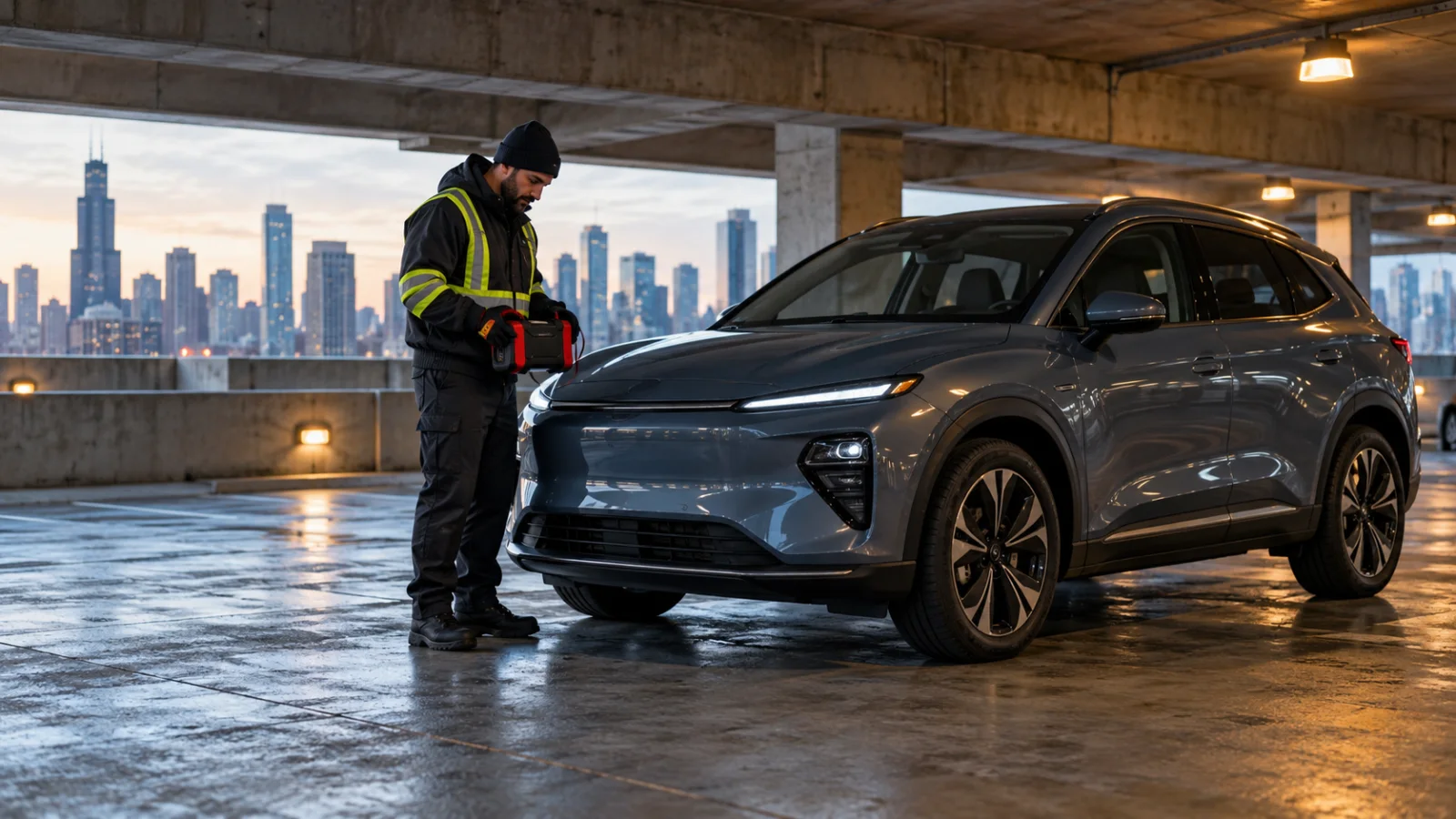
Start with what still works
Look at the car before anyone attaches a winch. A fully dark dash, silent locks, and no response from the start button point to the low-voltage side. A working dash with a zero-range warning points toward the traction pack instead.
Those failures need different help. A 12V jump can restore electronic controls when the small battery is down. It does not add driving range to the high-voltage pack. Mobile EV charging adds energy to the traction pack when the car can still communicate with charging equipment.
Do not force the shifter, pry at the parking brake, or pull a locked wheel. Tell the operator whether the dashboard lights, whether the doors respond, and whether the car shows a remaining charge. That information decides whether the first tool should be low-voltage support, charging equipment, dollies, or a flatbed.
Neutral is not one universal EV setting
Gas-car habits cause trouble here. Some EVs use a touchscreen transport mode. Some have a temporary Neutral setting meant for a car wash. Some return to Park after a short period. A sequence from one model can be wrong for another.
Tesla’s Model 3 manual says the touchscreen is used to enter Tow Mode. If the car has no low-voltage power, Tesla says an external low-voltage supply is needed to use that screen. If Tow Mode still cannot be activated, Tesla directs transporters to use self-loading dollies or tire skates.
Ford makes a different distinction on the Mustang Mach-E. Its Temporary Neutral limitation says the mode may be unavailable when the 12V charge is low. Ford also says not to tow the vehicle in that temporary mode. That is why “I got it into Neutral” is not enough information for a tow.
The Chevrolet Equinox EV has its own limit. The Equinox EV manual says the vehicle is not designed to remain in Neutral for an extended period and can shift back into Park automatically. It also says the vehicle is not designed to be towed with wheels on the ground.
The practical rule is simple: open the towing or transporting section for the exact model year. Do not use a forum sequence for a different car.
What the operator needs before moving the car
Give the operator a short, useful handoff:
- Make, model, and model year
- Whether the dash and interior lights work
- Whether the car can enter Ready mode
- Whether the parking brake releases
- Whether Neutral, Tow Mode, or Transport Mode appears on screen
- Whether the car is front-wheel drive, rear-wheel drive, or all-wheel drive if you know
- Whether the car sits in a garage, tight curb space, or live traffic lane
Kia’s EV6 towing instructions recommend wheel dollies or a flatbed for disabled-vehicle towing. They also say that when the parking brake and gear-change operation are unavailable, the driven wheels must be kept off the ground. That is checkable direction from the manufacturer, not a reason to guess which wheels can roll on another EV.
A low-clearance garage changes the equipment that can reach the car. A tight Chicago curb changes the loading angle. Give the garage level, entrance clearance if it is posted, and the nearest column or cross street. The operator can decide what fits before arriving.
When a jump solves the Park problem
A low-voltage jump can wake the computers and give you access to the maker’s transport controls. It is a diagnostic and control step. It does not guarantee that the vehicle is safe to drive.
After low-voltage power returns, check the dash. If the traction pack still has usable range and no other warning blocks driving, the operator can help you decide whether the car can leave under its own power. If the pack is empty, the next step may be an out-of-charge recovery. If the car still will not release Park, the next step is model-correct transport equipment.
Do not keep cycling a jump pack if the car wakes and immediately dies again. The underlying 12V problem may still need service. Do not treat a warning about the high-voltage system as a routine jump call.
When the car should not move
If there is smoke or fire, move away from the car and call emergency services. Kia’s towing guidance warns about a second-fire risk after a battery fire and says to contact the fire department.
For an ordinary no-start with no collision damage, do not let urgency turn into a locked-wheel drag. The correct manual procedure and the right loading equipment matter more than getting the car to roll immediately.
Charge Pro CHI is a referral line. We connect you with an independent local operator. We do not perform the jump, charge, or tow. The operator confirms the method for your car, quotes the work, and bills you directly.
Frequently asked questions
Can a dead 12V keep an EV stuck in Park?
Yes. Several EVs use low-voltage power for the screens and controls needed to select a transport or towing mode. The correct recovery sequence depends on the exact model and year.
Should I use a car-wash Neutral mode for towing?
Not unless the owner’s manual explicitly says that mode is for the planned movement. Ford says the Mustang Mach-E’s Temporary Neutral Mode is not for towing. Chevrolet says the Equinox EV can return to Park automatically. Read the towing section, not only the shifting section.
What if the car still will not release Park after a jump?
Stop trying to roll it. Tell the operator the low-voltage power is back but Park will not release. They can check the manufacturer procedure and use dollies, tire skates, or a flatbed where the manual calls for them.
If your EV is dark and will not shift, call (708) 412-5005. We will connect you with a local operator who can identify whether the first need is a 12V jump, a mobile charge, or transport equipment.