A stalled electric car in Carol Stream needs the right kind of help. The first step is deciding whether you need a 12V jump, a mobile charge, or vehicle transport.
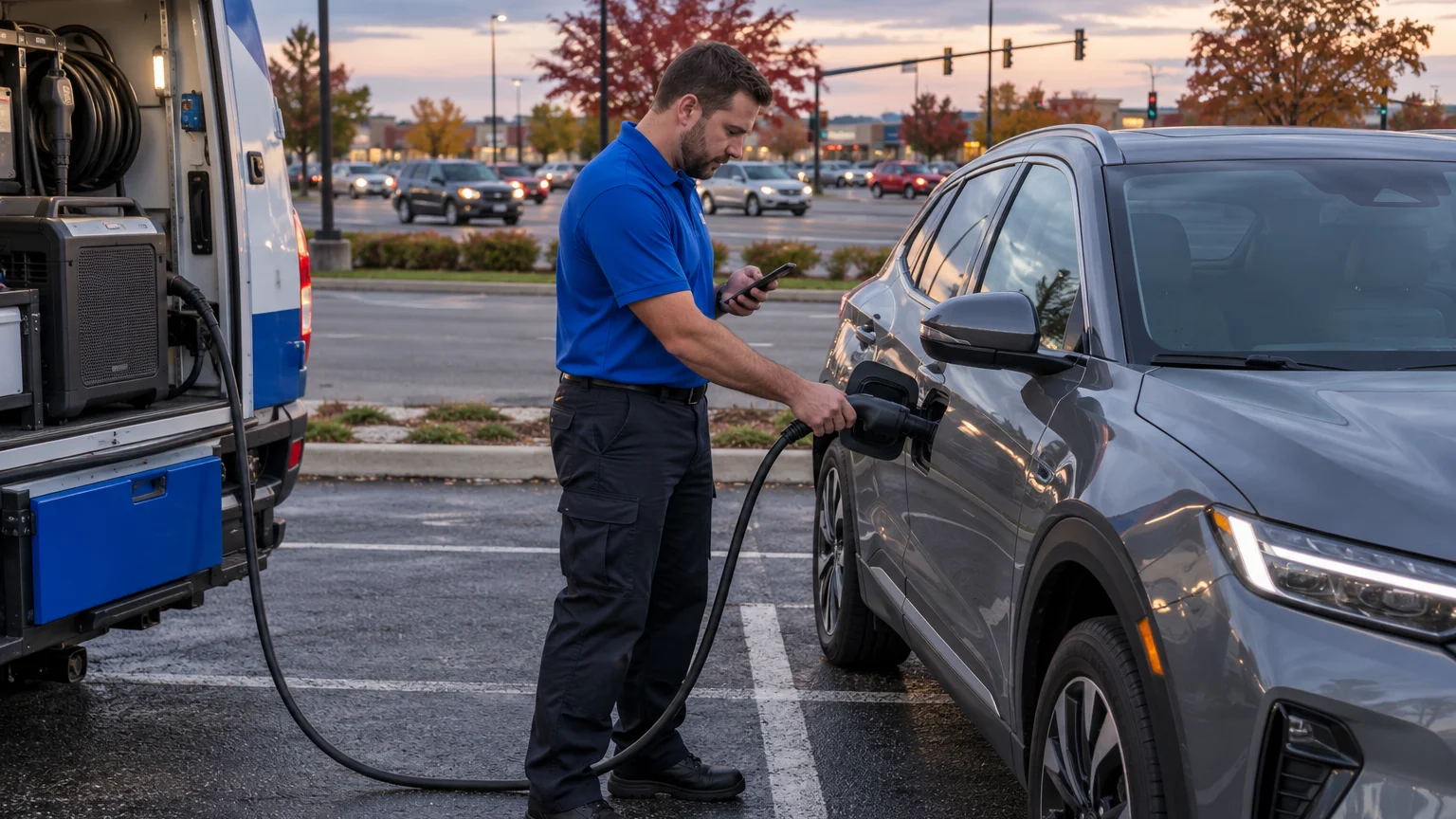
Charge Pro CHI connects drivers with licensed, independent local operators. The operator assesses the vehicle, quotes the work, and bills you directly. We don’t perform roadside work, own rescue trucks, set prices, or promise an arrival time.
Where Carol Stream drivers become stranded
A dead EV can become a very different problem depending on its location. In Carol Stream, that might mean a commercial lot near North Avenue, an apartment parking area, or an industrial property with controlled access.
Start by recording the exact location shown on your phone. Add a business name, building number, lot entrance, or nearby intersection. “Carol Stream” alone leaves too much ground to search. A dropped map pin can help the matched operator identify the correct entrance.
Industrial and apartment properties can add access questions. A gate, loading area, parking deck, assigned space, or property rule may affect how an operator reaches the car. Tell the operator about those details before accepting the service. If access hasn’t been confirmed, contact the property manager or site representative.
Don’t assume a nearby charging icon solves the problem. A location may be private, blocked, occupied, or unavailable. No Carol Stream charging location or access rule was confirmed for this article. Check the charging network and the property before depending on a specific station.
Carol Stream is a distinct DuPage County service area, not a generic Chicago location. The Census Bureau’s 2024 estimate lists 39,556 residents. Drivers seeking EV roadside assistance here should describe the Carol Stream location itself, including the lot and nearest entrance.
If the car is exposed to moving traffic or another immediate hazard, follow directions from local authorities. Don’t attempt a roadside procedure that conflicts with the vehicle’s owner manual.
Plan around North Avenue and Gary Avenue
North Avenue and Gary Avenue are useful location references when requesting EV roadside assistance in Carol Stream. They’re still not precise enough by themselves. Give the matched operator the direction of travel, nearest intersection, and the side of the road or lot.
If you moved into a commercial parking area, identify the entrance you used. Large properties may have several driveways. The operator also needs to know whether the EV is in an open space, beside a curb, near a loading zone, or inside a restricted section.
For an industrial parking location, report anything that may limit access. That includes a locked gate, security desk, employee-only entrance, or space beside a building. Don’t claim that access is available until the property confirms it.
Apartment lots need similar detail. Tell the operator whether the car is outdoors, under a structure, or behind a gate. If the vehicle occupies an assigned space, explain how another vehicle can approach it. Ask management about visitor access when the answer isn’t clear.
West-suburban winter conditions can make these details more important. If snow blocks part of the space, mention it. If slush surrounds the charge port or the car sits beside a snowbank, share that too. Report any frozen component to the operator.
Drivers coming from nearby communities may also find the location advice in our Wheaton EV roadside guide and Glen Ellyn EV roadside guide useful. Those pages cover their own local situations. For Carol Stream service, keep your location notes specific to Carol Stream.
Separate a dead 12V from an empty pack
A no-start message doesn’t prove the main battery is empty. Before choosing a service, collect what the car actually shows. Avoid guessing about the failed component.
Write down the last state of charge you saw. Note whether the screens, locks, interior lights, app, or charge port respond. Record any warning exactly as displayed. Don’t clear messages before taking a photo.
Tell the operator whether the car stopped while driving or wouldn’t wake after parking. Also report whether it was connected to a charger. If it was plugged in, say whether the charger showed an error. Don’t assume the charger delivered energy simply because the cable was connected.
Low-voltage trouble can also affect transport preparation. Tesla says a Model 3 uses the touchscreen to enter Tow Mode. Without low-voltage power, an external low-voltage supply is needed to use that screen. Tesla directs transporters to use self-loading dollies or tire skates when Tow Mode can’t be activated.
Ford says Temporary Neutral Mode in a Mustang Mach-E may be unavailable when the 12V charge is low. An external power source may be needed. Ford also says Temporary Neutral Mode must not be used for towing.
These examples show why the vehicle model matters. Give the operator the full make, model, and model year. Follow the owner manual rather than applying instructions from another EV.
For broader background, the U.S. Department of Energy’s electric vehicle overview explains electric vehicles and their main components. For a roadside decision, your vehicle manual remains the model-specific authority.
Choose a jump, mobile charge, or tow
Your symptom notes help the operator determine the next step. Ask what service they’re proposing and why it fits the reported condition. The main choices are a low-voltage jump, a mobile charge, or transport.
A jump may be considered when the problem points toward the low-voltage system. It isn’t the same as charging the main traction pack. Ask the operator what procedure applies to your exact model, then follow the manufacturer’s instructions.
Mobile EV charging may fit when the main pack is depleted and the vehicle can accept a charge. The approved rescue benchmark is 10 to 20 miles of range from 15 to 30 minutes of Level 2 charging. That describes charging time, not operator arrival. It’s also a typical rescue amount, not a promise for a particular vehicle.
Before booking a mobile charge, report the connector your EV uses. Tell the operator about any charge-port warning, collision damage, visible cable problem, or frozen component. Don’t force a connection when the owner manual says otherwise.
A tow may be the appropriate path when the vehicle can’t accept a charge, can’t be prepared for movement, or needs diagnosis beyond roadside service. Transport requirements differ by model.
Kia recommends wheel dollies or a flatbed for a disabled EV6. When its parking brake and gear-change operation are unavailable, Kia says the driven wheels must be moved off the ground.
Chevrolet says the Equinox EV isn’t designed to remain in Neutral for extended periods. It may return to Park automatically. Chevrolet also says it isn’t designed to be towed with its wheels on the ground.
Share the model before transport is arranged. Ask whether the proposed method follows its manual. Charge Pro CHI doesn’t select the transport procedure or warranty the operator’s work. The licensed, independent operator handles those details directly with you.
No Carol Stream roadside price was verified for this article. Charge Pro CHI doesn’t set operator rates. Ask the matched operator for the current quote and what it covers before approving service.
Prepare the location for the matched operator
Good preparation starts with information, not roadside repair. Send the operator a map pin and a short description of the vehicle. Include its color, make, model, and parking position.
Photograph the dashboard message and the area around the car. If the charge port is involved, photograph it without forcing it open. Include the charger display when the car is connected at a property station.
Keep these details ready:
- The last displayed state of charge
- The exact warning shown by the vehicle
- Whether the screens, locks, and app respond
- Whether the car is in Park or another indicated state
- The make, model, and model year
- The closest lot entrance or intersection
- Any gate, garage, curb, snowbank, or access restriction
- Whether property approval is needed
Remove loose items only when you can do so without creating another hazard. Keep keys or key cards available for the operator. If another person owns the car, confirm that you’re authorized to request work.
Don’t try to push, drag, or tow the EV based on instructions for a different vehicle. The Model 3, Mustang Mach-E, EV6, and Equinox EV examples show that disabled-vehicle procedures aren’t interchangeable.
When speaking with the operator, ask whether the reported problem calls for a jump, mobile charging service, or transport. Confirm the price directly with that operator. Also ask what access, equipment, or property permission the operator needs.
If the car is at an apartment or industrial site, verify the correct entrance before the operator travels there. A clear pin and confirmed access can prevent confusion at a large Carol Stream property.
When to call us
Call when your EV won’t wake, has an empty pack, or needs model-appropriate transport in Carol Stream. We’ll refer you to an independent local operator who can assess the reported situation and quote the work directly.
Call us at (708) 412-5005 and we’ll connect you with a local EV rescue operator.