Your EV has stopped, and the nearest public charger no longer matters. You need roadside EV charging near your actual location, with equipment that comes to the car.
What roadside EV charging near you actually is
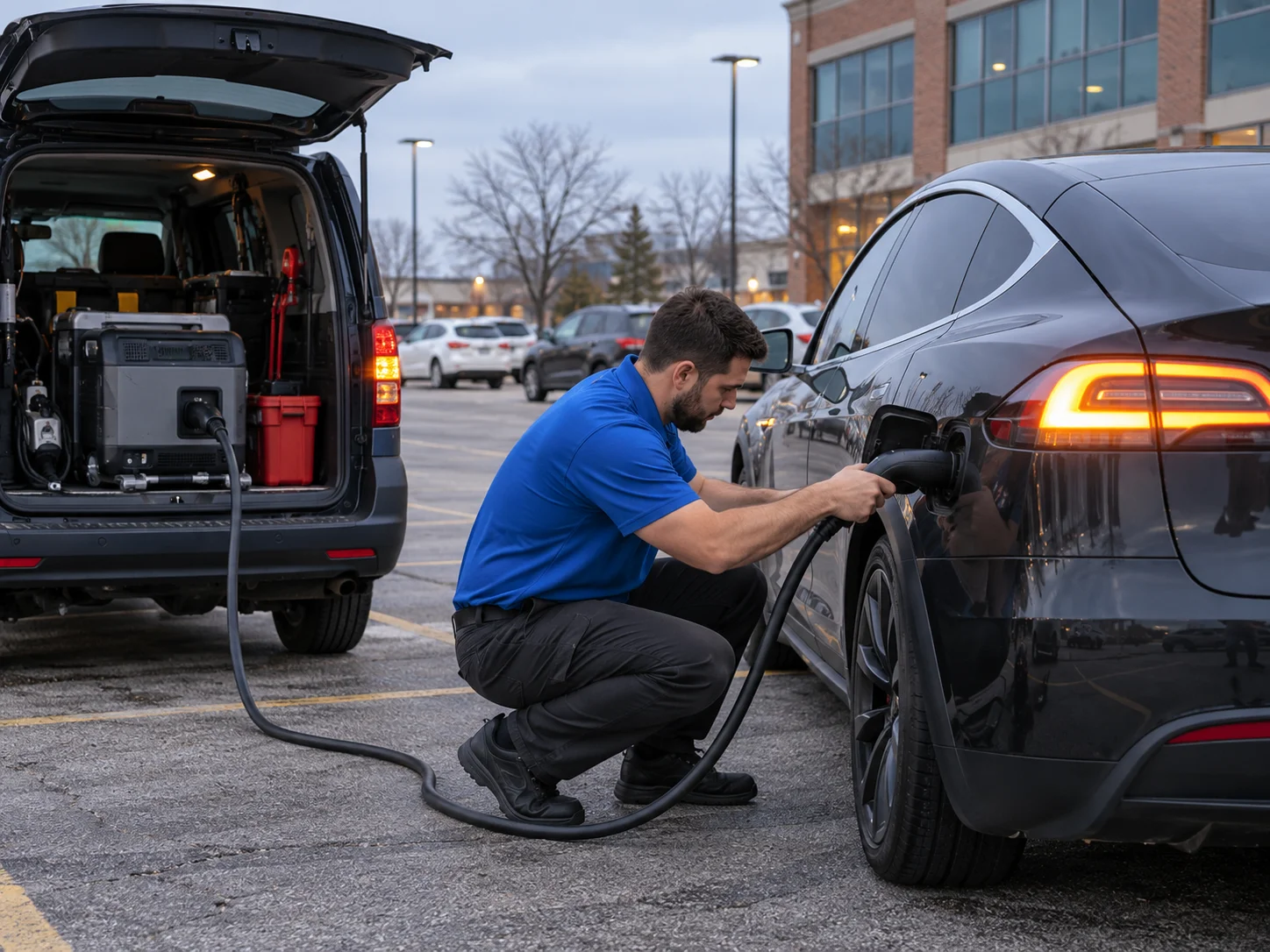
Roadside EV charging is a limited charging session at the vehicle. A local operator brings compatible equipment and connects it where the EV sits. The goal is usually enough range for the next practical stop, not a complete charge.
A typical rescue charge can add 10 to 20 miles of range. That estimate is based on 15 to 30 minutes of Level 2 charging. It describes charging time, not how long an operator takes to arrive.
Actual results can vary by the vehicle and situation. The approved information doesn’t support a promise for every model. Ask the operator what equipment will be used and what result is expected before authorizing service.
This is different from searching a map for an open stall. A public charger still requires your EV to reach it. Electric vehicle mobile charging brings the charging equipment to the stranded car instead.
It’s also narrower than general roadside coverage. A roadside plan may offer several kinds of help, but that doesn’t confirm a mobile charge is available at your location. Ask specifically for an on-site EV battery boost.
Our Mobile EV Charging service connects drivers with licensed, independent local operators. Charge Pro CHI doesn’t own the charging equipment or perform the session. The matched operator handles the work, sets the price, and bills you directly.
If you’re still able to move the car, our guide to mobile EV charging near you in Chicagoland helps separate a roadside boost from a public charging search. If the car can’t move, describe the exact symptoms before choosing either option.
Tow, 12V jump, or a pack boost
“Dead battery” doesn’t identify the right service. The operator needs to know what the vehicle does when you try to start it.
Report what you can see without diagnosing the car yourself. Say whether the screens turn on, whether the doors respond, and whether the vehicle shows a low-range or low-voltage warning. Also share the year, make, model, location, and current displayed range.
A mobile pack boost may fit when the EV has run out of usable driving range. A 12V jump is a different request. If you aren’t sure which battery is involved, give the operator the symptoms instead of ordering a specific procedure.
Towing may be the better match when charging isn’t available or the vehicle can’t accept a charge. Vehicle-specific transport instructions matter. They also aren’t interchangeable across models.
Tesla says Model 3 Tow Mode is reached through the touchscreen. Without low-voltage power, an external low-voltage supply is needed to use that screen. If Tow Mode can’t be activated, Tesla directs transporters to use self-loading dollies or tire skates.
Ford says Mustang Mach-E Temporary Neutral Mode may be unavailable when the 12V charge is low. An external power source may be needed. Ford also says Temporary Neutral Mode must not be used for towing.
Kia recommends wheel dollies or a flatbed for a disabled EV6. If parking-brake and gear-change operation aren’t available, the driven wheels must be off the ground. Chevrolet says the Equinox EV may return to Park automatically and isn’t designed for towing with its wheels on the ground.
Those differences are why a model-specific description matters. Our Emergency EV Roadside Assistance service can help match the request with an appropriate local operator.
Where Chicagoland drivers get stuck
A “near me” request can begin in very different Chicagoland settings. Access around the vehicle may shape which kind of help is practical.
One driver may lose the remaining range during a Kennedy crawl. Another may return to an EV in a Woodfield parking lot and find that it won’t move. An Oak Park driver may be parked inside condo parking with restricted access. A Will County driver may be stopped along an I-80 shoulder.
Give the operator more than a city name. Share your map pin, travel direction, nearby cross street, and the level or section of a parking structure. Mention gates, height limits, loading rules, or security procedures that could affect access.
On a highway, don’t describe your location only as “near Chicago.” State the road, direction, and the nearest exit or visible marker. On a surface street, provide the nearest intersection. Inside a large lot, name the entrance and a fixed landmark.
Don’t move the vehicle just to make the location easier to explain. If the car is already somewhere that presents immediate danger, contact emergency authorities. The charging operator can address the vehicle request, but that request doesn’t replace emergency help.
Chicagoland coverage also doesn’t mean every operator has identical equipment at every moment. Charge Pro CHI serves 49 cities and communities across eight regions, but a specific charging option still needs confirmation for your vehicle and location.
The broader guide to roadside assistance for EVs in Chicagoland explains how roadside categories differ. This page focuses on one need: getting a limited charge brought to a stranded EV.
What a quote covers, and what it does not
Charge Pro CHI doesn’t set roadside prices. The independent operator provides the quote and bills the driver directly.
No verified Chicagoland market rate for this service is available in the approved claims ledger. That means we won’t publish a guessed range. Confirm the current total with the operator before you pay.
Ask what the quote covers before authorizing the visit. Confirm whether it covers the proposed charging session, the equipment needed for your vehicle, and any location conditions you already described. If the operator proposes towing or another service, ask for that scope separately.
A clear quote should match a clear request. Tell the operator whether the EV is on a road, in a garage, at a home, or inside a commercial lot. Provide the vehicle model and visible symptoms. State whether you’re asking for a traction-pack boost, low-voltage help, or an assessment because you aren’t sure.
Also ask what happens if the vehicle won’t accept the proposed charge. Don’t assume the original quote automatically includes transport, a second service, or further troubleshooting. Get the operator’s answer before work begins.
Arrival time should be handled the same way. Charge Pro CHI doesn’t promise an ETA. Ask the matched operator for its current estimate, then confirm it again if traffic or access conditions change.
The charging result needs confirmation too. The verified typical rescue figure is 10 to 20 miles of range after 15 to 30 minutes of Level 2 charging. It isn’t a promise for your EV. Ask what charging level is planned and what result the operator expects for your specific vehicle.
Keep the operator’s quote and service description together. That gives both sides the same understanding of the requested work.
Matching you with a local charging operator
A useful match begins with accurate details. Send the vehicle year, make, and model. Include the displayed range, warning message, and what happens when you try to start or shift.
Next, share the exact location. A pin is helpful, but add plain-language directions. “Lower level near the west entrance” is better than a pin alone inside a parking structure. On I-80, include direction and the nearest exit. Near Woodfield, identify the lot and entrance.
Mention anything that limits vehicle access. That includes garage clearance, locked gates, loading restrictions, or a property manager’s entry process. Don’t assume mobile charging equipment can reach every parking space.
Then confirm the requested outcome. If you only need enough range to leave the location, say that. If the screens are dark and you suspect a low-voltage issue, describe those symptoms. If the car won’t shift, tell the operator before equipment is sent.
Charge Pro CHI uses those details to connect you with a licensed, independent local operator. The operator decides whether it can handle the vehicle and location. It also provides the quote, performs the work, and collects payment.
We don’t guarantee that mobile charging will fit every breakdown. A charging session may not address a no-start condition unrelated to available driving range. A tow may also require model-specific procedures, as the Tesla, Ford, Kia, and Chevrolet instructions show.
That’s why the best “EV roadside assistance near me” request is specific. Ask for the service the car appears to need, but leave room for the operator to review the symptoms. Clear information helps avoid sending charging equipment for a vehicle that needs another form of recovery.
When to call us
Call when your EV can’t reach a charger and you need a local operator to assess a mobile range boost. You can also call when the symptoms don’t clearly point to charging, a 12V jump, or towing.
Call us at (708) 412-5005 and we’ll connect you with a local EV rescue operator.