Hazard lights on the Eisenhower do not tell the next truck what you need. Roadside assistance for an EV has to match the stall: empty traction pack, a silent 12-volt, or a tire that will not hold air. Call a gas-car wrecker for a drained pack and you sit through a tow you might have skipped with a mobile charge.
What roadside assistance for an EV actually does
Roadside assistance for an EV is a mix of old jobs and new ones. A flat, a lockout, or a car in a ditch still looks like a gas-car call. The traction pack does not. There is no spare gallon of electricity in the trunk. If the high-voltage battery is empty, a wrecker without a charger can only haul the car.
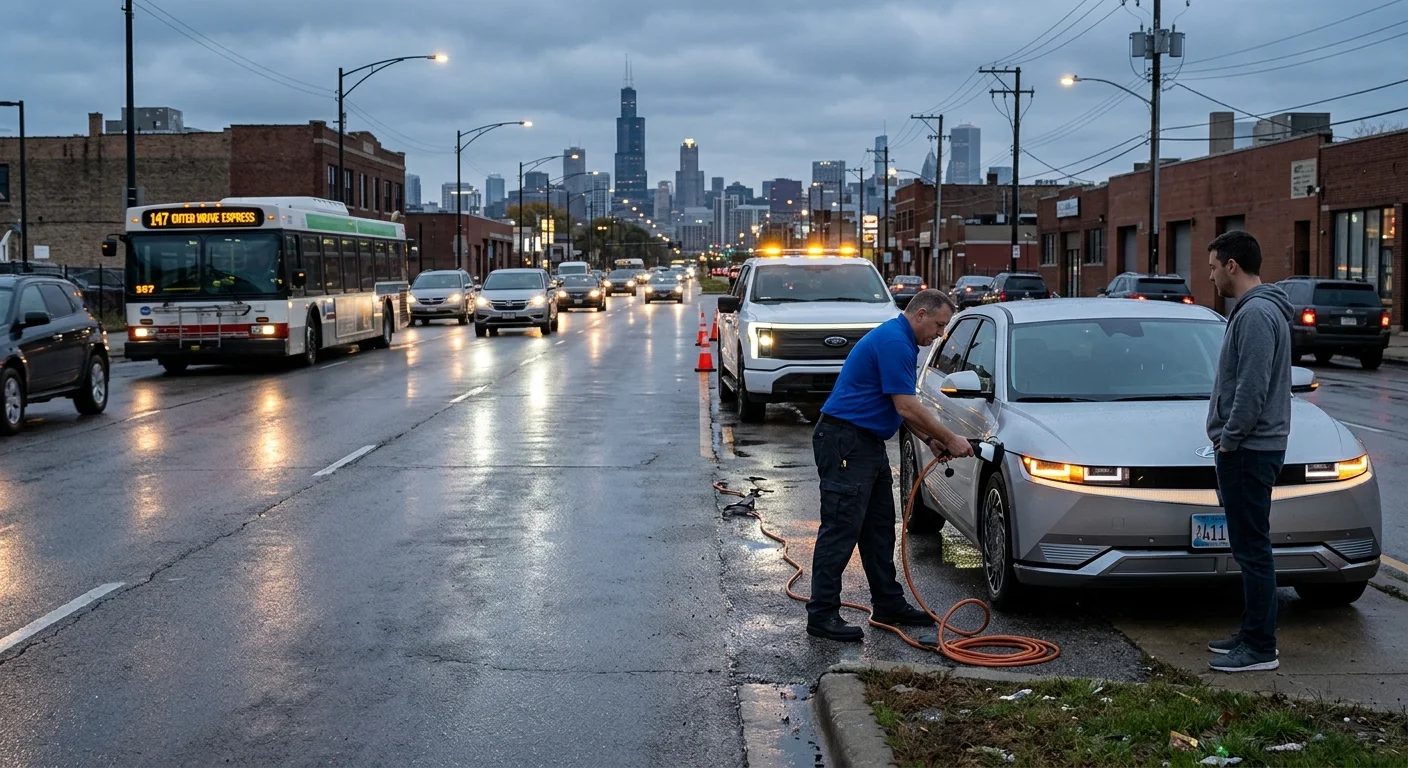
A roadside crew can charge an EV only if they bring charging hardware. A local operator with mobile EV charging gear can add range at the curb. That is roadside assistance EV charging in the literal sense: electrons at the car, not a ride to a plug. The typical rescue charge is 10 to 20 miles of range in 15 to 30 minutes of Level 2 charging. That window is charging time, not how long it takes anyone to arrive. Charge Pro CHI does not set prices and does not promise an arrival clock. The operator who shows up quotes the work and bills you directly.
Not every truck that answers an EV roadside assistance call carries a charger. Some only jump the 12-volt accessory battery. Some only winch or load a flatbed. When you call, say the make, the connector you use (CCS, NACS, or CHAdeMO), and whether the screens are dark or the range just hit zero. That split is the whole job. The U.S. Department of Energy keeps a plain overview of how electric vehicles work if you want the systems in one place. For the stall in front of you, the need is simpler. You need electrons, a 12-volt jump, or a tow.
On the Dan Ryan, the Kennedy, or Lower Wacker, the stall has to fit the street. A North Shore driveway is not a Cicero curb boxed in by parked cars and a CTA bus.
Empty pack, dead 12V, or a tire: three different calls
Three stalls get lumped under one search. They are not the same call.
Empty pack. The car still talks to you. Range is zero, or so close you will not make the next charger. Hazard lights work. Doors unlock. This is a candidate for a mobile Level 2 boost, not a 12-volt jump. A jump of the little battery will not refill a drained traction pack. Our charge, jump, or tow note walks that fork. On the Dan Ryan with a zero on the display, ask for an empty-pack recovery.
Dead 12-volt. Screens go black. The charge port may not open. The car will not wake up even if the big pack still holds energy. Cold mornings on street parking in Oak Park, Berwyn, and Cicero make this more common than a garage stall in Wilmette. A 12-volt jump, done to the car’s own procedure, can wake the computers. It does not replace a pack that is actually empty. If you cannot tell which battery failed, which EV battery matters when you are stranded is the local check.
If the low-voltage failure also leaves the car unable to shift, use the EV stuck in Park after a dead 12V guide before anyone tries to move a locked wheel.
Tire or mechanical. Flats, lockouts, and winch-outs still happen to EVs. We do not have a verified local puncture rate to quote. A tire change does not fill the pack, and a charger does not reseat a bead. Tell the operator which problem you have. If the car must move and the pack is dead, many owner’s manuals call for a flatbed so the driven wheels stay still. Confirm that in your manual before anyone hooks a chain. Emergency EV roadside assistance is the bucket for mixed stalls.
Stay out of live lanes. On the Tri-State or the Eisenhower, wait somewhere safe if you can leave the car. We could not confirm a dedicated CDOT motorist-assist program for Lower Wacker or Lake Shore Drive. Call 911 if you are in the travel lane and cannot move.
Why a Chicagoland stall is not a gas-car stall
Chicago is not one parking pattern. The city proper’s ACS 2019-2023 population is 2,707,648 (U.S. Census Bureau). That density shows up at the curb. Cicero still has 90.2 percent of its housing built before 1980. Oak Park sits at 78.6 percent. Street parking, tight alleys, and cars stacked along Cermak or Madison leave little room for a long wrecker. North Shore towns such as Wilmette, Glenview, and Highland Park more often have driveways a van can pull into.
Expressways add another layer. An empty pack on the Dan Ryan is a live-traffic problem. Lower Wacker is a low-clearance stall with few places to stage a truck (our Lower Wacker note). A stall on the Tri-State is a shoulder and a wall of trucks. We do not publish a charger count or a miles-to-plug figure for any of those roads. Those numbers were not verified for this site. Name the mile marker, the nearest exit, and whether you are on the shoulder or a city block.
A gas-car stall ends with a can of fuel. An EV stall ends with a connector that has to match your inlet, a 12-volt jump that has to follow the car’s posts, or a flatbed that has to keep the driven wheels off the pavement. Winter makes the 12-volt more likely to fail after a night on the street. It also cuts usable range. We will not invent a percentage for that cut. You feel it on the Kennedy at dusk in January.
If you want the prep version of this, the existing Chicagoland EV roadside assistance guide covers what to do before you are fully stuck. This page is the commercial side: who you actually call, and for which job.
OEM clubs, AAA, and a local charging operator
Your car’s brand may include a roadside number in the app or the glovebox. Coverage and whether they send a charger change by model year. If that policy is not on the maker’s public page for your car, treat it as unconfirmed. Call the number in the app. Ask if they will charge on site or only tow.
AAA EV roadside assistance is the other number people already have. A membership can cover tire work, lockouts, and some 12-volt jumps on an EV the same way it would on a gas car. Whether AAA will send a mobile charger in Chicagoland is not a fact we can publish. We could not confirm a current, public, Chicago-specific AAA mobile-charging rule that holds as a durable claim. Check your club’s own page and your membership level. Our AAA or mobile EV charge note is the local fork if you are choosing tonight.
How much roadside EV charging costs is a quote, not a website number. Charge Pro CHI sets no price. The matched operator quotes you and bills you. There is no verified metro-wide dollar figure, so we will not invent one. Ask for the quote before work starts. Ask what you get for it. 10 to 20 miles of range is the typical rescue charge after 15 to 30 minutes of Level 2 charging. That is energy delivered, not a fee.
A local charging operator is the third option when the club cannot charge on site, the OEM will only tow, or you want a connector-matched boost on a Cicero curb or a Naperville lot. You contract with that operator. They are the licensed, insured party. We are the match.
How we connect you with a vetted local pro
Charge Pro CHI is a referral service. We match you with licensed, independent local EV charging professionals. We do not send our own truck. We do not employ crews. We hold no trade license and we give no warranty. The operator you are connected with is licensed and insured, quotes the job, and you pay them.
We serve Chicagoland: 49 cities and communities in 8 regions, from Waukegan and Gurnee down through the South suburbs and out to Aurora, Elgin, Joliet, and Crystal Lake. Tell us where the car sits, the make, and which of the three stalls you have. If you need emergency EV roadside assistance, say so. If you already know the pack is empty and the screens still work, ask for mobile EV charging.
If you are on I-55, I-90, Randall Road, or a Schaumburg mall lot, say the road and the nearest landmark. The operator prices the job from that pin, not from a national average. We do not publish hours, and we do not promise a clock. Stay with the car if it is safe. Have the charge-port door, your key, and a photo of the inlet ready. We connect. They do the work.
When to call us
Call when the pack is empty, the 12-volt is silent, or you are not sure which battery failed and you need a local EV rescue operator at the curb. Do not wait on a club policy you have not confirmed. Call us at (708) 412-5005 and we’ll connect you with a local EV rescue operator.