A Model Y on the Kennedy shoulder at 1 a.m. still needs a clear hours answer. Tesla roadside assistance exists, and you request it in the app. A published 24/7 hours line for Chicago could not be confirmed on Tesla’s public pages for this article, so the live request screen is the source you should trust.
What Tesla publishes about after-hours roadside
Tesla runs a roadside assistance program for owners in the United States. You start Tesla emergency roadside assistance from the Tesla mobile app. You can also follow the contact path Tesla shows on its current support pages. For a Chicago night stall, that in-app screen is the document that matters.
A durable hours statement, including a 24/7 line tied to Illinois, could not be confirmed for this piece. Tesla edits support copy. The labels on the request flow change by software, model, and account. Treat any third-party roundup that quotes a clock as unverified until you open your own ticket.
If the app lets you submit a roadside request at 2 a.m., Tesla is taking that ticket then. If the screen says a service is unavailable, limited, or closed for the night, that is Tesla’s answer for that VIN. Read it twice before you assume a wrecker is coming.
Cost sits in the same unverified bucket. Search results talk about complimentary tows, mile caps, warranty years, and per-service fees. None of those dollar figures, mile limits, or coverage windows could be verified. Tesla’s current roadside price list for Illinois could not be confirmed here. Open Tesla’s roadside and warranty text in the app or on tesla.com and read what attaches to your car. If a number is missing from Tesla’s own screen, ask Tesla Support to show the line before you authorize work.
Does Tesla have roadside assistance. Yes. Tesla offers it, and the app is how most owners start it. How does Tesla roadside assistance work at night. You describe the failure, you share a pin, and Tesla tells you what they will send. Is Tesla roadside assistance 24/7. That is a hours question, and hours live on Tesla’s side. Check them the night you stall. For the phone-versus-app choice, see Tesla roadside: phone or app, what to use.
Why a 24/7 badge is not the same as a pack boost
A 24/7 badge on a roadside plan means a ticket can be opened overnight. A pack boost is a separate job. Tesla may send a tow, a lockout tech, or tire help. An empty high-voltage pack needs energy at the charge port. A dead 12V needs a low-voltage wake. Those three failures feel the same from the sidewalk. They need different equipment.
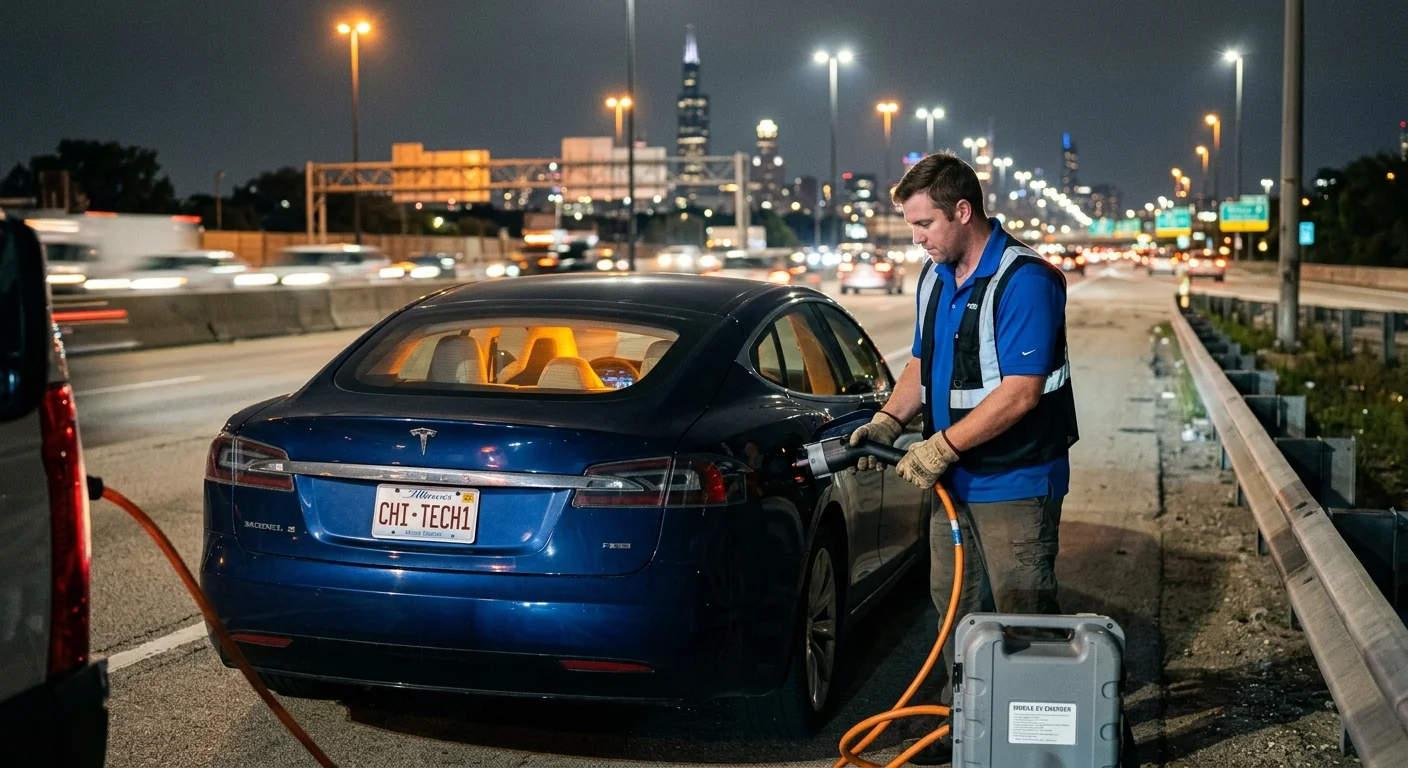
Chicago nights make the split obvious. Street parking in Lakeview and Lincoln Park is tight between parked bumpers. Lakefront lots go quiet after the last harbor walk. Lower Wacker has low clearance and columns that block a long bed. A flatbed that cannot square up still leaves the car in place. A mobile Level 2 session from a local operator is a charge event. Typical rescue charging, as we describe it, is 10 to 20 miles of range in 15 to 30 minutes of Level 2 charging. That figure is charging time. It is not an arrival promise.
Name the battery before you request help. If the screen is black, the handles will not present, and the app cannot wake the car, you are likely in 12V territory. Match that to a Tesla 12V battery jump. If the car is awake, range reads near zero, and the charge port still opens, the pack is empty. Tesla roadside may offer a tow to a service center. A local operator may charge in place so you can drive to a charger yourself.
Flats are a third case. A down tire with remaining range is tire work or a tow. Tesla’s current tire rules belong on Tesla’s site. This page does not publish a coverage list Tesla did not confirm. Keep the request honest: tire, 12V, or empty pack.
The U.S. Department of Energy pages on electric vehicles explain pack charging in general terms. They will not tell you what Tesla will send to the Dan Ryan at 1 a.m. Tesla’s own screen will.
Overnight stalls on the Kennedy, Dan Ryan, and Lower Wacker
Night on the Kennedy (I-90/94) can sit in a crawl, then open into empty concrete. A Tesla on the shoulder has a wall on one side and traffic on the other. Put the hazards on. Keep climate modest if the pack still has energy. Stay in the car when lanes are moving. If you are stopped in a live lane and cannot reach the shoulder, call 911.
The Ohio Street feeder, the Edens split, and the stretch by Irving Park all pinch the apron. Night barrels shift that apron without warning. If the display still works and the range is gone, you have an empty-pack stall. Do not run cabin heat down to the last indicated mile if you still have a path to a charger. If you are already stopped, Tesla’s app is the first request.
The Dan Ryan south of the Loop repeats the wall-and-shoulder geometry. Chinatown, 35th Street, and the 95th Street approaches add night construction and short merge lanes. An awake car with zero range is a charge problem. A dark car that will not unlock is a 12V problem. Say which one you have on the ticket.
Lower Wacker is its own map. Clearance is low. Columns are close. GPS often pins you on Upper Wacker. In the Tesla app, write lower level, eastbound or westbound, and the nearest ramp: Wabash, Michigan, Lake, or Columbus. A dead EV on Lower Wacker is a placement problem as much as a battery problem. Charge vans and wreckers both need a legal, reachable pad. If Tesla’s assigned truck cannot fit under the deck, put that on the ticket and ask Tesla what they will do next.
Lakefront lots from Lincoln Park to Museum Campus strand cars after a long dwell. The pack looked fine at dinner. Sentry and cabin overheat protection can pull the 12V down for hours. That is the lockout pattern: the car looks dead, the port will not open, the app spins. Street parking in Lakeview north of Belmont and in Lincoln Park near the zoo does the same thing on a colder night.
A Naperville garage, an Elgin lot, or a Waukegan overnight street stall fails in a quieter way. The inner-city stall is clearance and speed. The suburb stall is a gate and a dark row of cars. Tesla still needs an accurate pin in every case.
How to check Tesla’s app when it is late
Open the Tesla app on cellular. Garage Wi-Fi you already left will not help on the Kennedy. Go to Service or Roadside, whatever Tesla labels it on your software. Read the whole request screen before you tap submit. That screen is Tesla’s live policy for your VIN, including whether Tesla emergency roadside assistance is offering a service at that hour.
The app has your location, your model, and your account. A phone call only helps if Tesla’s own page still lists a number and someone picks up. We are not printing a Tesla phone number here. Tesla moves those lines. Copy the number from Tesla’s current support page or from the in-app contact path.
Describe the failure in Tesla’s categories. Empty high-voltage battery. Cannot wake / 12V. Flat. Lockout. Tow. If the app offers mobile charging, read whether it is included, billed, or unavailable. If charging is absent from the list, Tesla is not sending a pack boost on that ticket.
Drop a pin a driver can use. “Kennedy, west of Ohio Street” beats “Chicago.” “Lower Wacker, eastbound at Wabash” beats “downtown.” “Lakeview, street parking north of Belmont” beats “North Side.” A photo of the shoulder, a mile marker, and the charge port helps the person Tesla assigns.
If the app errors, retry on LTE. If the car is asleep and the app cannot reach it, treat it as a 12V event. Remote climate commands will not wake a dead 12V. Warranty questions, including whether a stop is complimentary, belong in Tesla’s coverage text. Those complimentary-versus-paid rules could not be confirmed as current Illinois figures for this article. Tesla’s own documents are the authority.
When a local operator is the backup if OEM cannot charge you
Use Tesla’s path first when the app is taking requests and the car is in Tesla’s program. A local operator is the backup when Tesla will not charge the pack in place, when the offer is a tow you do not want, or when the app cannot finish.
Charge Pro CHI is a referral service. We connect stranded drivers with licensed, independent local EV rescue operators. We do not own trucks. We do not run a fleet. We do not perform the work. The operator you match with quotes you, bills you, and does the charge or the 12V job. We set no price. We publish no arrival window.
That backup is Tesla roadside rescue when the pack is empty and you need miles to a charger. It is the 12V jump service when the cabin is dark. It is emergency EV roadside assistance when you cannot tell which battery failed and you need a matched pro on site.
When Tesla’s screen has no mobile charge, a local Level 2 boost is the in-place option. Typical charging is 10 to 20 miles of range in 15 to 30 minutes of Level 2. Confirm the quote with the operator before they start. If Tesla is already sending a flatbed, stay with that plan unless you cancel with Tesla first. Two trucks on Lower Wacker helps no one.
Who to call if a Tesla battery dies. Start in Tesla’s app. If Tesla cannot charge you on the Kennedy, the Dan Ryan, Lower Wacker, or a Lakeview curb, that is when a matched local operator is the backup.
When to call us
Call when Tesla’s request screen will not send a pack boost, or when the car is dark and you need a 12V match in Chicago. Stay on the shoulder, keep the pin accurate, and tell the operator whether the port opens. Call us at (708) 412-5005 and we’ll connect you with a local EV rescue operator.