A parked Tesla can appear completely unresponsive when you need to leave Huntley. Before requesting a Tesla 12V jump, separate a possible low-voltage problem from an empty traction pack or another fault.
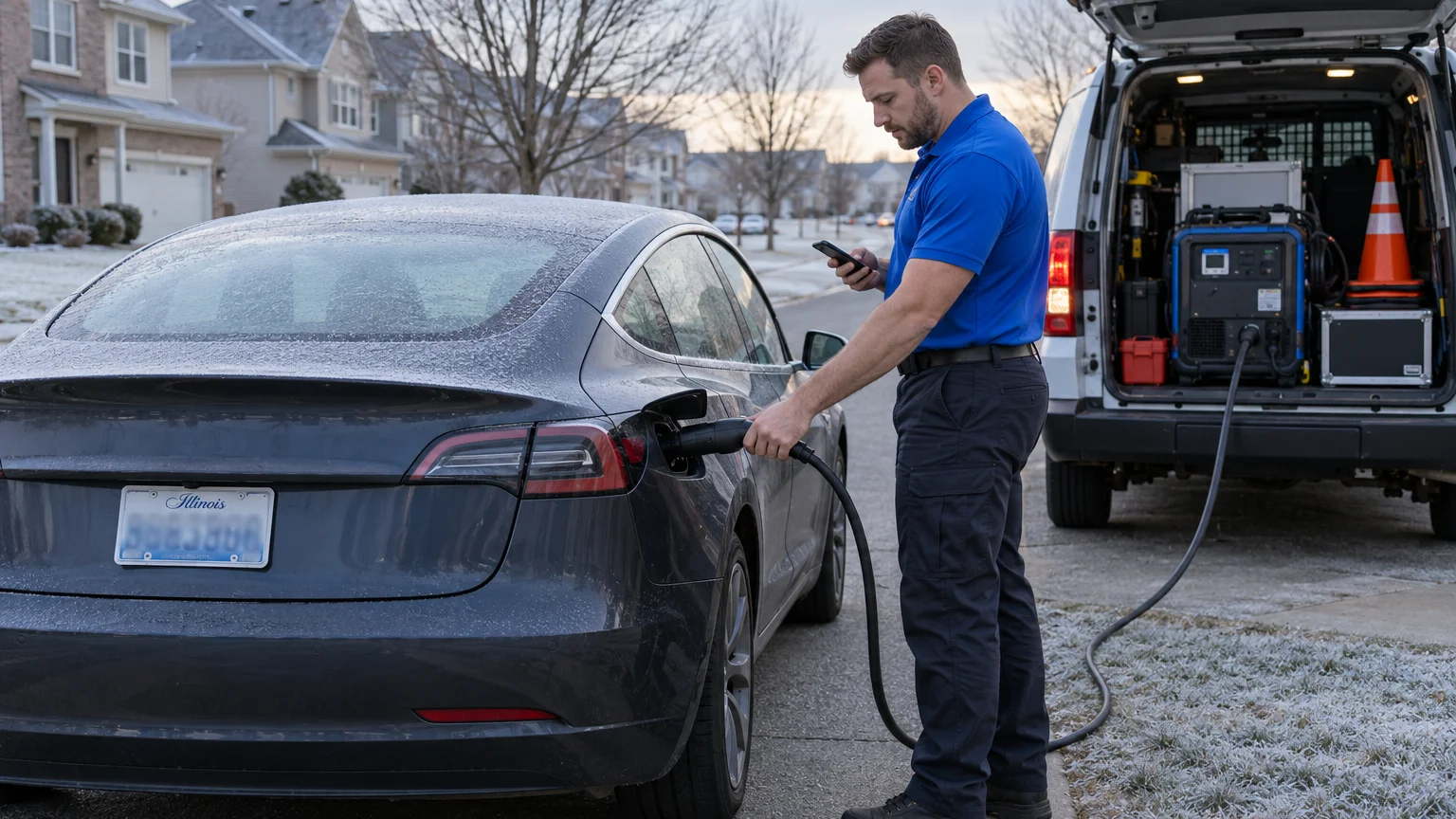
Recognize a 12V failure before blaming the pack
Start by recording exactly what happens when you approach the Tesla. Check whether the doors respond, the touchscreen wakes, the app connects, or any warning appears. Don’t treat one symptom as a confirmed diagnosis.
A Tesla has a low-voltage system and a separate traction battery. General EV background is available through the U.S. Department of Energy’s electric vehicle overview. However, that overview doesn’t diagnose your particular Tesla.
The distinction matters because a Tesla 12V jump and a traction-battery boost address different problems. If the displayed driving range reached empty before the car stopped, share that detail. If the Tesla was parked with usable range and later became unresponsive, report that sequence instead. Neither observation proves the cause by itself.
Write down any warning message exactly as shown. Don’t shorten it to “dead battery.” That phrase can describe several different situations. A screenshot from the Tesla app may also help the operator understand what you’re seeing.
Our guide to a dead Tesla pack versus a 12V problem explains the questions that help separate those two situations. You can also review the broader signs in our Tesla 12V troubleshooting guide.
If you’re requesting help, describe the Tesla as unresponsive rather than declaring the battery defective. The operator can then arrive prepared for the reported symptoms without relying on a guess.
Check the manual for the correct access point
Tesla access and low-voltage procedures can vary by model and configuration. The approved source material doesn’t confirm one universal jump procedure for every Tesla. Check the owner’s manual matched to your vehicle before opening panels or connecting an external supply.
Use the manual available through your Tesla or Tesla’s official owner resources. Confirm the model, model year, and the procedure shown for that vehicle. Don’t substitute instructions from a different Tesla because its exterior looks similar.
Charge Pro CHI doesn’t publish a universal terminal location because that detail couldn’t be confirmed for every configuration. The matched operator should also know your exact model before attempting access. Tell the operator if the front trunk is closed, the doors won’t open, or the touchscreen remains dark.
Tesla’s approved Model 3 transport guidance adds an important distinction. Tesla says Tow Mode is reached through the touchscreen. Without low-voltage power, an external low-voltage supply is needed to use that screen. If Tow Mode can’t be activated, Tesla directs the transporter to use self-loading dollies or tire skates. You can review the source in the Tesla Model 3 Owner’s Manual.
That transport instruction isn’t a general jump-start procedure. It explains why a powerless Model 3 may require special planning before movement. It also shows why guessing at access points can create a second problem.
Our Tesla 12V Battery Jump service page explains how Charge Pro CHI connects drivers with licensed, independent local operators. The operator performs the physical work and quotes the driver directly.
Plan around Route 47 and I-90 locations
Location details matter when your Tesla won’t start in Huntley. A subdivision driveway presents a different access problem than a parking space near Route 47. A vehicle near the I-90 edge may also require different positioning than one parked at home.
Give the operator a precise location that can be shared safely. Include the street address or parking-area description when available. Mention whether the Tesla sits inside a garage, under a low ceiling, beside another vehicle, or at the end of a narrow driveway.
For a Route 47 parking location, identify the business or lot entrance shown on your map. Don’t rely only on “near Route 47.” That description can leave too much ground to search. If you’re near I-90, share the mapped location and whether the Tesla is in a lot or stopped beside a traveled route.
Cold outdoor parking is also useful context. Tell the operator how long the Tesla sat outside and what happened when you returned. Don’t assume the weather proves the 12V system failed. It’s one part of the sequence, not a diagnosis.
If the vehicle is in an exposed or active traffic area, describe that immediately. Charge Pro CHI doesn’t set arrival times or control operator availability. Clear location details still help the independent operator evaluate the request.
Huntley drivers comparing a household power issue with a stranded-car problem can read our guide to a home battery or mobile EV boost in Huntley. A home backup question is separate from a Tesla low-voltage no-start.
Know when a jump will not solve it
A jump shouldn’t be treated as a promised repair. It may provide the low-voltage power needed for the next diagnostic step, but the approved claims ledger doesn’t establish that every unresponsive Tesla can be restored by a jump.
If the Tesla responds and then becomes unresponsive again, tell the operator what changed. Don’t keep repeating an improvised procedure. A recurring no-start may need inspection beyond roadside assistance, but the cause can’t be confirmed from symptoms alone.
A jump also won’t refill an empty traction battery. If the Tesla stopped after its displayed range fell to empty, say so when requesting help. The operator can evaluate whether the situation calls for mobile charging or transport rather than a low-voltage jump.
Transport may also require model-specific preparation. For a Model 3 without low-voltage power, Tesla’s manual says an external low-voltage supply is needed to use the touchscreen for Tow Mode. If Tow Mode can’t be activated, the transporter should use self-loading dollies or tire skates.
That’s why the first call should describe the condition, not prescribe the solution. Our Tesla Roadside Rescue page covers referrals for Tesla-specific roadside situations. Charge Pro CHI connects you with a local operator, while that operator decides what service is appropriate and sets the price.
Share the Tesla model with the operator
Start with the full model name: Model 3, Model Y, Model S, Model X, or Cybertruck. Add the model year if you know it. Don’t describe the car only as “a Tesla with a dead battery.”
Next, share the sequence. Explain where the Tesla is parked, how long it sat, and what happened when you approached. Report whether the touchscreen responds and whether you can open the doors or front trunk. Quote any warning message exactly.
Tell the operator what you already tried. Include any external power connection, app command, charging attempt, or roadside visit. This prevents the next person from working from an incomplete history.
Also describe the parking position. A Tesla facing into a Huntley garage may have different access around it than one parked in an open Route 47 lot. Mention tight walls, nearby cars, a closed garage door, or limited space in front of the vehicle.
Use this short checklist when requesting help:
- Tesla model and model year
- Exact Huntley location
- Current access to the cabin and front trunk
- Touchscreen and app response
- Warning text shown
- Displayed range before the problem
- Steps already attempted
- Garage, driveway, lot, or roadside position
You don’t need to diagnose the failed component. Accurate observations are more useful than a confident guess. They help the operator decide whether to discuss a low-voltage jump, mobile charging, further inspection, or transport.
Charge Pro CHI is a referral service. We don’t jump batteries, replace Tesla parts, own rescue equipment, or set operator prices. We connect drivers with licensed, independent local EV operators, and the driver contracts with the operator directly.
When to call us
Call when your Tesla is unresponsive in Huntley and you need a local operator to evaluate a possible low-voltage issue. Share the model, exact location, symptoms, and any warning shown.
Call us at (708) 412-5005 and we’ll connect you with a local EV rescue operator.