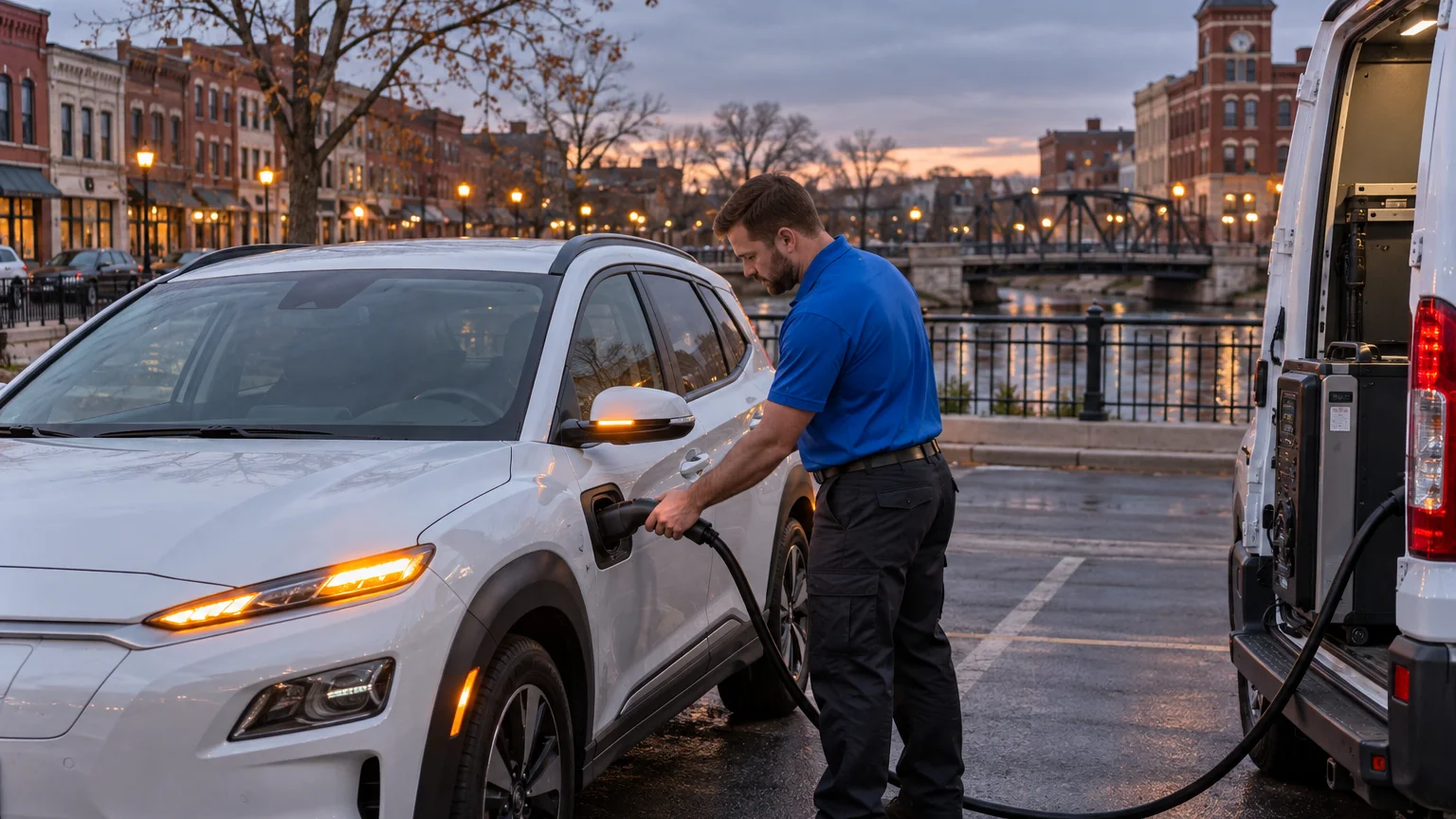
A stalled EV in Batavia creates an immediate choice. You need to determine whether mobile charging can help or the vehicle needs transport. Charge Pro CHI connects drivers with licensed, independent local operators who handle the rescue.
Where Batavia drivers become stranded
A low battery can become urgent on Randall Road. Traffic, frequent stops, and limited places to pull aside can complicate the situation.
Downtown creates a different problem. Riverfront parking areas may have narrow entrances, parked cars, pedestrians, or restricted access. Tell the operator whether your EV is outdoors, inside a garage, or behind an access gate. A vehicle’s location within a lot matters more than the business name alone.
Fabyan Parkway and the Fermilab edge bring another set of details. A pin dropped beside a long road may not identify your entrance or direction. Share the nearest cross street, your travel direction, and a recognizable public landmark.
If you’re out of charge on Randall Road, follow our Randall Road recovery guide while arranging help.
Batavia had an estimated population of 26,555 in 2024, according to the U.S. Census Bureau figure recorded in our verified claims ledger. The city sits within Charge Pro CHI’s Chicagoland service area. We connect stranded drivers with local operators, but we don’t operate rescue vehicles or perform roadside work.
Plan around Randall Road and riverfront access
Before booking help, identify a safe and reachable meeting point. “Near Randall Road” isn’t enough for an operator choosing equipment and an approach. Send a map pin, the property entrance, and your exact parking position.
For a retail lot, include the storefront or lot section nearest you. For downtown riverfront parking, mention the entrance you used and any height barrier. If you’re beside Fabyan Parkway, give your direction of travel. Near the Fermilab edge, explain whether you’re on a public roadway or private property.
Don’t assume every rescue vehicle can enter every garage or tight lot. Clearance, turning space, locked gates, and parking rules can affect access. These facts help the matched operator decide whether mobile charging is practical. They also help determine whether different transport equipment is needed.
Winter adds another layer. Snowbanks can remove usable shoulder space. Ice can make an otherwise simple loading position difficult. Cold weather may also change what the dashboard shows as the vehicle sits. Report the displayed range, warnings, and outside conditions without diagnosing the cause yourself.
If the EV still has power, preserve it while waiting. Turn off unnecessary cabin accessories if your owner’s manual recommends doing so. Follow the vehicle maker’s instructions for your exact model.
Our EV roadside assistance service can connect you with an independent local operator. That operator sets the price, explains the work, and bills you directly. Ask about the proposed service and total charge before authorizing it.
Separate a dead 12V from an empty pack
An EV has a high-voltage traction pack and a separate low-voltage system. Either can leave the vehicle unable to move, but they call for different help. A mobile charge won’t necessarily solve a low-voltage failure.
An empty traction pack often follows declining displayed range and low-charge warnings. The displays may still work even though the vehicle won’t drive. A low-voltage problem can look different. The doors, screens, charge-port controls, or gear selection may stop working properly.
Those clues aren’t a final diagnosis. Share what happened before the stall. Tell the operator whether the range reached zero, the screens remain active, or the vehicle is stuck in Park. Include every warning exactly as shown.
Access points and procedures vary by model. The U.S. Department of Energy’s EV overview explains the basic role of batteries and electric-drive components, but your owner’s manual controls the roadside procedure for your vehicle.
Transport also depends on the model. Tesla says a Model 3 without low-voltage power may need an external low-voltage supply to access Tow Mode through the touchscreen. If Tow Mode can’t be activated, Tesla directs transporters to use self-loading dollies or tire skates.
Ford says a Mustang Mach-E may not offer Temporary Neutral Mode when its 12V charge is low. Ford also says that mode must not be used for towing. Kia recommends wheel dollies or a flatbed for a disabled EV6. These manufacturer instructions show why the operator needs your exact year, make, and model.
Check nearby charging before choosing a tow
A nearby charger only helps when your EV can reach it and the station works for your vehicle. Don’t rely on an old screenshot or a charger marker alone. Check current status through the charging network’s app or website before choosing a destination.
No specific Batavia charging location could be confirmed from the approved claims ledger for this page. Connector availability, access, and operating status can change. Verify those details directly with the network operator before paying for a tow or trying to move the EV.
Start with four checks:
- Confirm the charger appears available in the network’s current listing.
- Confirm its connector works with your vehicle or approved adapter.
- Check whether the property is open and accessible.
- Confirm your remaining range can reach it without guesswork.
If the pack is empty, mobile EV charging may provide enough energy to reach a suitable charger. The verified typical rescue charge is 10 to 20 miles of range during 15 to 30 minutes of Level 2 charging. That describes charging time only. It isn’t an arrival estimate or a promise for every vehicle.
A tow may be the better choice when the EV won’t accept a charge, has collision damage, shows a serious fault, or can’t be placed into its required transport mode. The matched operator should follow the manufacturer’s instructions.
Drivers south of Batavia may also find our Aurora EV roadside guide useful. Confirm the actual destination before authorizing transport. Charge Pro CHI doesn’t select charger networks, set towing prices, or guarantee station access.
Prepare details for the matched operator
Good information helps an operator bring suitable equipment. Start with the vehicle’s year, make, model, and displayed battery level. Mention whether it’s fully electric or a plug-in hybrid. Don’t describe it only as “an electric car.”
Next, explain what still works. Can you unlock the doors? Does the main screen turn on? Can you open the charge port? Will the vehicle shift into Neutral or a transport mode? Report any warning message word for word.
Share these location details:
- Your map pin and nearest public cross street
- Your direction of travel
- The parking lot or garage entrance
- Any gate, clearance bar, ramp, or tight turn
- Whether the EV blocks traffic
- Snow, ice, standing water, or visible vehicle damage
Take a clear photo of the vehicle’s position if you can do so safely. A photo can show curb height, garage clearance, or limited loading space.
Ask the operator what service is proposed. Mobile charging, low-voltage assistance, and towing aren’t interchangeable. Ask whether the planned equipment matches your model’s transport instructions. Request the operator’s price before approving the work, since Charge Pro CHI doesn’t set or collect that charge.
Manufacturer roadside programs and insurance plans may offer different benefits. Their coverage, battery-replacement terms, exclusions, and charges weren’t confirmed in the approved ledger. Check your current policy, vehicle app, warranty documents, or roadside membership before assuming a rescue is included. A roadside operator may restore mobility, but battery replacement depends on the diagnosed problem and the terms of your coverage.
When to call us
Call when your EV is stranded in Batavia and you need a mobile charge, low-voltage help, or model-appropriate transport. Charge Pro CHI will refer you to a licensed, independent local operator who explains the service and bills you directly.
Call us at (708) 412-5005 and we’ll connect you with a local EV rescue operator.