The Supercharger you aimed for on the North Shore is a line of Model Ys, or the Kennedy crawl burned the last miles you had. A local operator can bring a 240-volt boost to the Tesla so you can roll to a working charger. That on-site session is what most drivers mean when they search mobile Tesla charging in this metro.
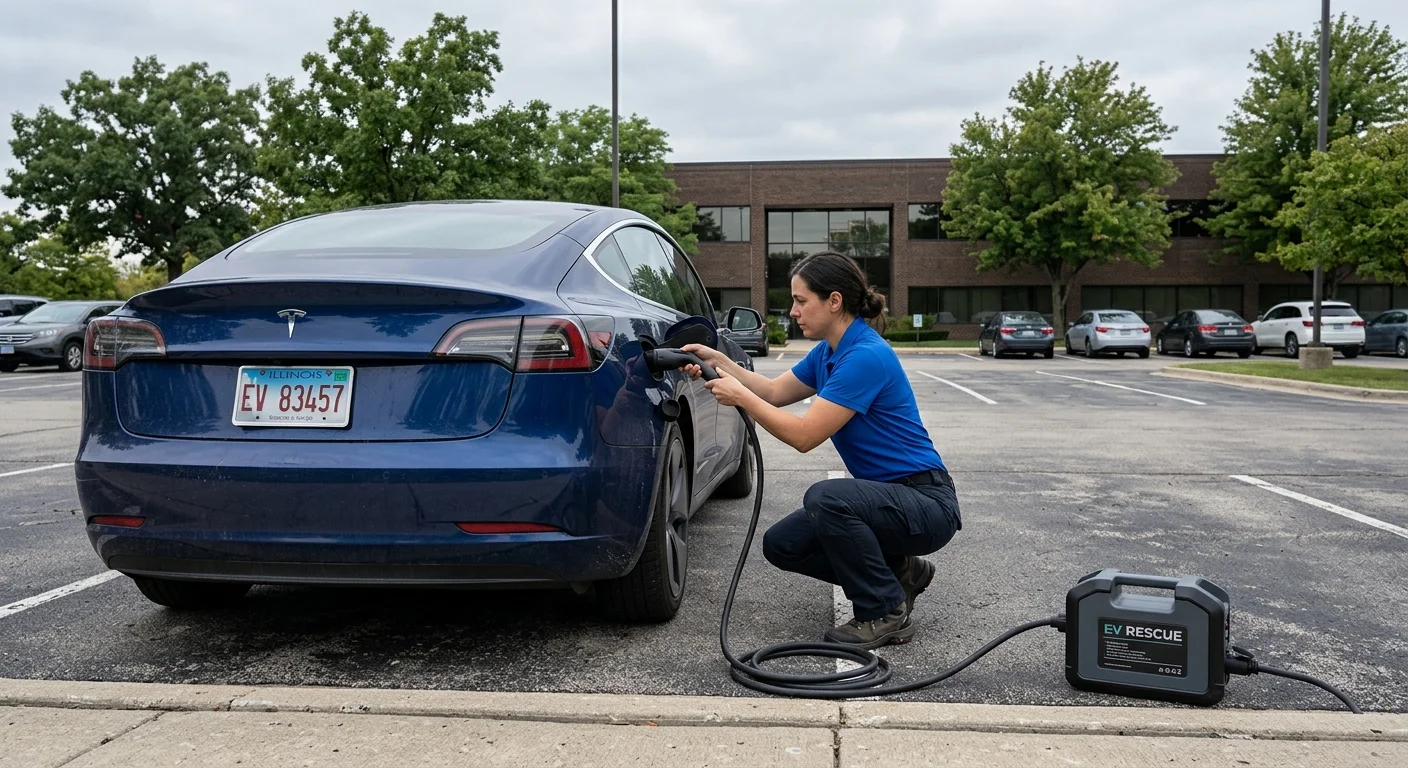
What mobile Tesla charging means on site
Searchers mix up two products under the same phrase. One is the portable mobile tesla charger Tesla sells, the brick that lives in a tote or the trunk. The other is a tesla charging service that comes to you. This page is the service.
When you are stranded, an independent operator parks near the car and seats a handle in your Tesla charge port. You stay with the vehicle. The session is Level 2, which is AC charging at 240 volts, not a Supercharger fill. A typical rescue charge adds 10 to 20 miles of range in 15 to 30 minutes of Level 2 charging. That window is cable time. It is not an arrival clock.
Those miles have one job. You need enough range to leave a Kennedy shoulder, an Oak Park condo stall, or an office-park curb in Schaumburg and reach a public charger that actually works. You are not filling the pack to 100 percent at the bumper.
A portable connector only helps if you can reach a working outlet. A household 120-volt plug is slow. A 240-volt garage receptacle is faster, and it still needs a circuit that can take the load. None of that helps if you are already sitting off I-90 with no outlet in reach. That is when mobile EV charging is the right call: power comes to the Tesla.
Tesla’s network still matters on a normal day. Superchargers and destination chargers are how most Model 3 and Model Y drivers refill. The U.S. Department of Energy outlines how EV charging levels work without the sales pitch. Level 2 is the same class of charging a local operator uses on site. It is slower than DC fast charging. It is enough to unstick you.
A home wall unit is a different project. If you are shopping for the fastest Tesla home charger, you are planning a garage install, not a rescue. Do not treat a stranded boost as a stand-in for a dedicated home circuit.
People also look for a Tesla mobile charger extension. A current official extension SKU could not be confirmed here as a durable fact. Check Tesla’s own accessory list before you buy a third-party cord. Do not daisy-chain random extension cords into a charge port. If you have no outlet, an extra cord will not invent one. Book the on-site boost.
OEM roadside versus a local 240V boost
Tesla Roadside Assistance is the factory path. What it covers, who it sends, and how long the wait runs are not confirmed as durable figures on this site. Check Tesla’s current policy in the app. What drivers here usually see is a tow toward a Supercharger, not a 240-volt session at the bumper. If you are still sorting those two ideas, read Tesla charging service or a local boost. This page assumes you already want the boost.
A local 240-volt boost is a different product. An independent operator quotes you, parks legally near the car, and runs Level 2 into the pack. You pay that operator directly. Charge Pro CHI does not set the price, does not run the session, and does not own the truck.
OEM help is the better call when you have a flat, a 12-volt no-start, or a car that will not accept charge. Tesla roadside rescue is the matching path for those jobs, including a 12-volt jump when that is what the car needs. A mobile tesla charger service will not wake a Tesla that has a dead 12-volt battery. The high-voltage port stays dark until the low-voltage system comes back.
The local boost is the better call when the pack is simply empty. The nearest Supercharger is full, offline, or farther than the miles on the screen. You need 10 to 20 miles to get out of the pin. That is tesla mobile charging as a booked job, not as a brick in the trunk.
Do not expect Tesla’s app to dispatch a Chicagoland independent for you. The app talks to Tesla’s own roadside vendors. A local operator is a separate booking. If you already opened a Tesla ticket, tell the local operator that, so two crews are not rolling to the same pin.
Insurance roadside and club roadside are a third lane. They often default to a tow. If the goal is to keep the Tesla on its wheels, say you want a charge, not a hook. A flatbed still has a place when the car will not take power, or when you are blocking a live lane.
Where Tesla drivers stall in this metro
Chicagoland is not one parking lot. The stall looks different on the Kennedy than it does in a North Shore queue or an Oak Park condo pad.
Kennedy crawls eat range. I-90/94 through the Northwest Side turns a planned Supercharger stop into a 2 percent problem, especially when lake wind and winter cabin heat are both on. Drivers count on a cabinet after the crawl and then find every stall taken or the unit dark. Sitting in a gore point with almost no range is a mobile Tesla charging job only if you can stay legally parked and visible. If you are in a live lane, get to a shoulder or an exit first. Call 911 if the car is a hazard.
North Shore Supercharger queues are their own trap. Evanston, Skokie, Wilmette, Glenview, and Highland Park pull Tesla traffic along the lakefront and the Edens. Evening peaks fill the public stalls that exist. A live charger count for those towns could not be verified for this page, so this site does not publish one. What you can verify in the car is the wait on the screen. If that wait is longer than the range you have left, a curb boost in a legal spot beats gambling the last miles.
Oak Park condo lots strand people in a quieter way. Oak Park’s housing is old. U.S. Census ACS 2019-2023 figures put 78.6 percent of units built before 1980. Shared lots, brick courtyards, and street parking rarely include a 240-volt outlet you are allowed to use. A Model Y that sat at 8 percent after errands on Lake Street or Harlem does not crawl to a suburban Supercharger without a plan. The operator needs a legal place to park next to you, a clear charge port, and your account unlocked so the car will accept charge.
Office parks along I-88, I-90, and I-355 add a weekday version of the same bind. You leave a meeting in Schaumburg or Naperville, the workplace pedestal is blocked by a gas car or sitting idle, and the pack will not make the next Supercharger. Same service: tesla mobile charging at the curb, then you drive.
Inner-ring streets in Cicero and Berwyn have tight lots and alleys. If that is your pin, the Berwyn mobile Tesla charging notes cover that grid. Chicago itself is 2,707,648 people on the ACS 2019-2023 count. The stalls follow the cars: garage podiums, residential blocks with no overnight charging, and expressway shoulders after a crawl. The local geography is the point. A page that swapped in another metro would miss the Kennedy, the North Shore queue, and the Oak Park lot.
What a quote usually covers, and what it does not
Charge Pro CHI does not publish a brand price. The operator you are matched with quotes the job and bills you. Confirm that quote before anyone plugs in.
A typical quote for mobile Tesla charging is a Level 2 on-site session. Ask what energy they plan to add, in miles or percent, and how long they expect the cable to stay in. The only charging-time figure this site can stand behind is the typical rescue charge: 10 to 20 miles of range in 15 to 30 minutes of Level 2 charging. Your car, the outdoor temperature, and the operator’s equipment can land outside that band. If the quote names a different window, believe the quote in front of you.
What a quote usually covers is the roll to your pin once you agree, a 240-volt session into a Tesla that will accept charge, and enough range to reach a public charger you name. What it usually does not cover is a full pack, a guaranteed arrival clock, a tow, body or charge-port work, or Supercharger fees after you leave. A 12-volt jump is a different job unless the operator writes it into the same quote. Overnight parking tickets stay yours if you chose an illegal stall.
No one on this site promises minutes, same-day language, or a 24-hour brand clock. Ask where they want the car. A Kennedy shoulder, a condo fire lane, and a Naperville office aisle are three different setups. Ask whether they can work in rain or lake-effect snow. Illinois winters are hard on cables and screens. If they cannot work the pin, you want that answer before you wait.
Pay the operator, not the referral line. Get the business name on the quote. If a number on the quote looks off, stop and ask. Market rates for this work are not listed as a verified dollar figure on this site, so there is no public menu to check against. The check is the written quote, confirmed before the handle goes in.
Matching you with a local charging operator
Charge Pro CHI is a referral service for Chicagoland. The brand matches you with licensed, independent local EV charging professionals. It performs no work, employs no crews, owns no trucks, and holds no trade license. You contract with the operator. The pros we connect you with are licensed and insured. Their quote, their cable, their invoice.
When you call, have the pin, the model (3, Y, S, X, or Cybertruck), the percent on the screen, and whether the car still wakes. Say if Tesla roadside is already rolling. Say if the 12-volt system looks dead. That last point changes the job from a boost to a no-start.
The service area is 49 cities and communities across eight regions of the metro. Chicago, the North Shore, the northwest suburbs, the west suburbs, the Fox Valley, and the south suburbs sit on that map. Describe the lot, the nearest cross street, and whether a van can stand next to the charge port. Then we match you with an operator who will quote that pin.
You still make the hire. If the quote is wrong for you, decline it. If you need a tow instead, say that. If you only needed a portable connector for a garage you can already reach, you do not need this service.
Keep the car in Park, the charge port clear of ice, and a person on site who can authorize the session. Tesla’s app lock settings can block a charge if the car is asleep and the phone is dead. Have a key card or a charged phone. Then the operator runs the session, you watch the miles return, and you drive to the charger you picked.
When to call us
When the pack is too low to reach a working Supercharger, or the lot you are in has no 240-volt outlet you can use, that is when you want a mobile EV rescue operator on site. Stay out of live lanes, keep the charge port clear, and have the car’s percent ready. Call us at (708) 412-5005 and we’ll connect you with a local EV rescue operator.