You’ve returned from a trip and found your EV powerless at Midway. Start by contacting the parking office or nearest lot attendant. Then contact a mobile EV rescue operator with your exact parking location.
Who can help at Midway or O’Hare
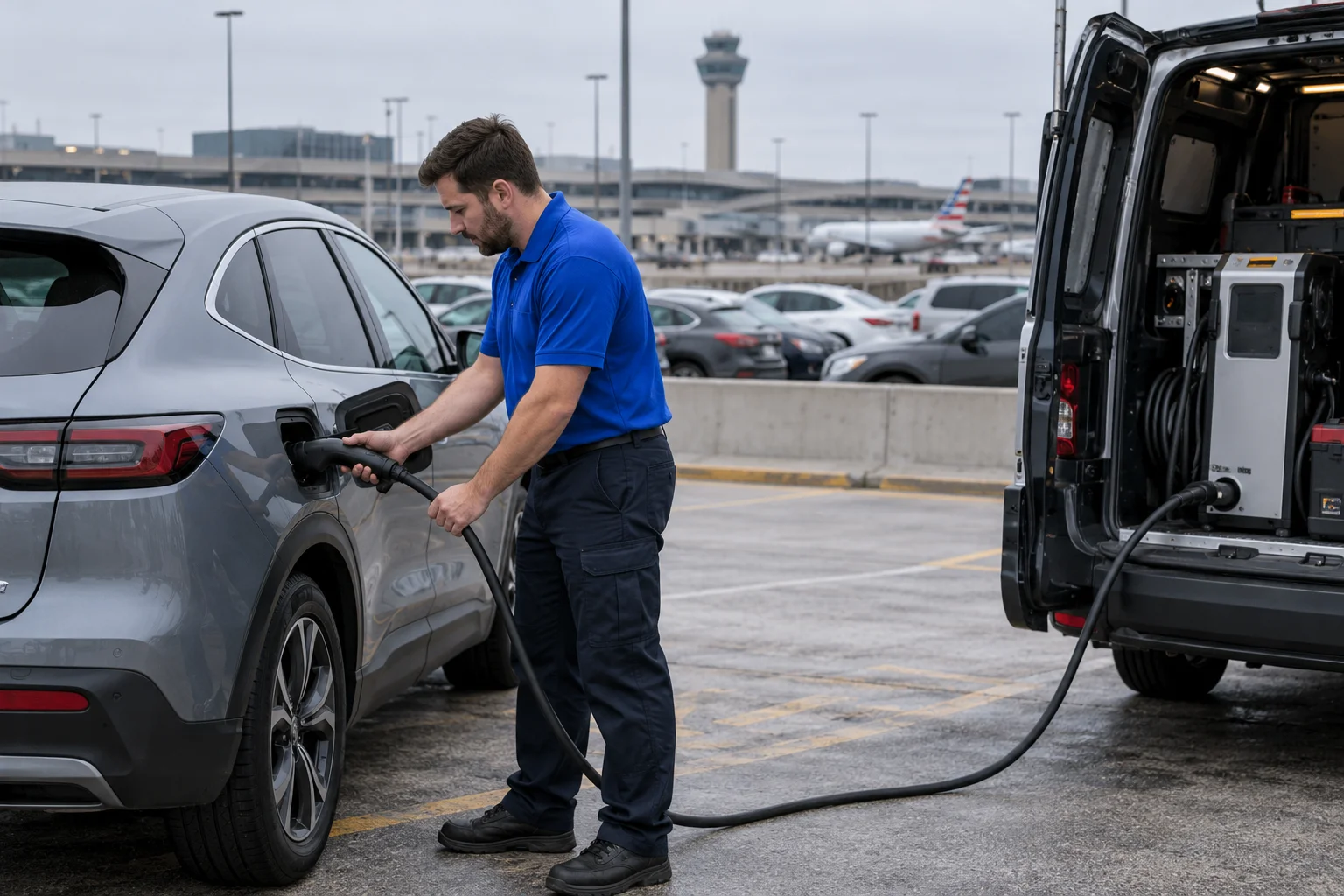
A mobile EV rescue operator may be able to assess the vehicle. The right service depends on what lost power. An empty traction battery, dead low-voltage battery, charging fault, or mechanical problem can require different equipment.
Charge Pro CHI connects drivers with licensed, independent local EV operators. The matched operator performs the physical work. That operator also decides whether mobile charging, low-voltage support, or transport fits the situation.
First, contact the airport parking office or find a lot attendant. Ask how an outside service provider can reach your vehicle. Share your parking ticket if staff needs it to identify the facility or entry lane. Don’t assume an operator can enter through every gate.
We couldn’t confirm current official lot names, garage clearances, or service-vehicle access rules from the approved airport record available for this page. Those details can change. Check the current parking information at flychicago.com, then confirm access with airport parking staff before booking service.
Use the lot or garage name shown on your ticket and nearby signs. Don’t rely on what you remember from departure day. O’Hare and Midway have different parking areas, and a vague airport location won’t help a driver find your vehicle.
If parking staff gives you special entry directions, write them down. Pass those instructions to the operator before service is accepted. Airport staff can address parking access questions, while the independent operator handles the EV rescue decision.
What to tell the operator before booking
Your airport name isn’t enough. Dispatch needs the location printed on signs near the vehicle. Walk to the closest level, row, zone, or elevator marker and copy its wording exactly.
Send these details when requesting help:
- O’Hare or Midway
- The lot or garage name shown on your ticket
- Level, row, section, or zone
- Nearby elevator, stairwell, or entrance marker
- Parking ticket details that help identify the facility
- Vehicle year, make, and model
- Remaining range or battery percentage, if visible
- Warning messages shown in the car or app
- Whether the doors, screens, and interior lights work
- Whether the charge port opens
- Any parking access instructions from airport staff
Tell the operator whether the car is parked nose-in or backed into the space. Mention nearby walls, columns, low ceilings, or tightly parked vehicles. These observations help the operator decide whether the proposed equipment can reach the car.
Photos can clarify the setting. Capture the vehicle, parking marker, surrounding space, and nearest entrance sign. Don’t photograph payment information or other sensitive ticket details.
Describe what happened without guessing at the failed part. “The screen is dark and the doors won’t respond” is more useful than declaring the main battery dead. A low-voltage problem can look different from an empty traction battery, but the operator must assess the actual vehicle.
You can also review our guide to which EV battery matters when stranded. It explains why a no-start condition doesn’t always mean the large battery pack is empty.
Mobile charging, low-voltage help, or transport
A vehicle that responds normally but shows an empty traction battery may be a mobile-charging candidate. A typical rescue charge can add 10 to 20 miles of range through 15 to 30 minutes of Level 2 charging. That’s charging time only. It isn’t an operator arrival estimate.
That added range may support a move to another charging location. The operator must confirm connector compatibility, access, and whether charging is appropriate. Airport parking rules and the vehicle’s condition can change the plan.
A dark screen, dead locks, or no electronic response may point toward the low-voltage system. Don’t force the charge port, doors, or gear selector. Give the operator the symptoms and vehicle model so the right procedure can be considered.
Transport may be necessary when the vehicle won’t accept a charge or can’t be moved normally. Manufacturer instructions matter here. For example, Tesla says a Model 3 without low-voltage power needs an external low-voltage supply to use the touchscreen for Tow Mode. If Tow Mode can’t be activated, Tesla directs transporters toward self-loading dollies or tire skates.
Ford says Temporary Neutral Mode can be unavailable on a Mustang Mach-E when the 12V charge is low. Ford also says that mode must not be used for towing. Kia recommends wheel dollies or a flatbed for a disabled EV6. Chevrolet says the Equinox EV isn’t designed for towing with its wheels on the ground.
Those examples aren’t universal instructions. Tell dispatch your exact model. The operator should follow that vehicle’s current manufacturer guidance.
Airport garage access can change the rescue plan
Airport parking adds a second problem beyond the disabled EV. The operator needs permission and physical access to reach the space. A suitable rescue vehicle outside the facility may not fit inside a garage.
No verified clearance figure was available for this page. Don’t estimate it from memory or rely on an old travel post. Ask the parking office for the current clearance at the entrance serving your vehicle. Then ask the operator for the height of the proposed service vehicle.
We also couldn’t confirm a universal airport rule for outside mobile charging or towing providers. Before accepting a quote, ask parking staff whether the operator may enter your specific facility. Ask whether someone must meet the operator at a gate, payment lane, or office.
If the operator can’t enter, don’t try moving a powerless EV without model-specific instructions. Ask the parking office and operator what handoff options are currently allowed. The answer depends on the facility, vehicle, and equipment involved.
Charge Pro CHI doesn’t control airport entry, parking gates, or garage clearances. We also don’t set the independent operator’s price or arrival estimate. The operator should quote the work directly after reviewing your vehicle and location.
Before accepting service, confirm what the quote covers. Explain whether the car needs enough energy to leave, low-voltage support, or transport. If you’re comparing those paths, read our guide to choosing a mobile charge or tow when stranded.
When to call us
Call when your EV can’t leave O’Hare or Midway parking and you need a mobile rescue operator to assess charging, low-voltage support, or transport. Call us at (708) 412-5005 and we’ll connect you with a local EV rescue operator.