If your EV died in a parking garage, don’t request a tow immediately. First, identify the likely power problem and confirm whether help can enter. A low ceiling, locked gate, or vehicle stuck in Park can change the whole recovery plan.
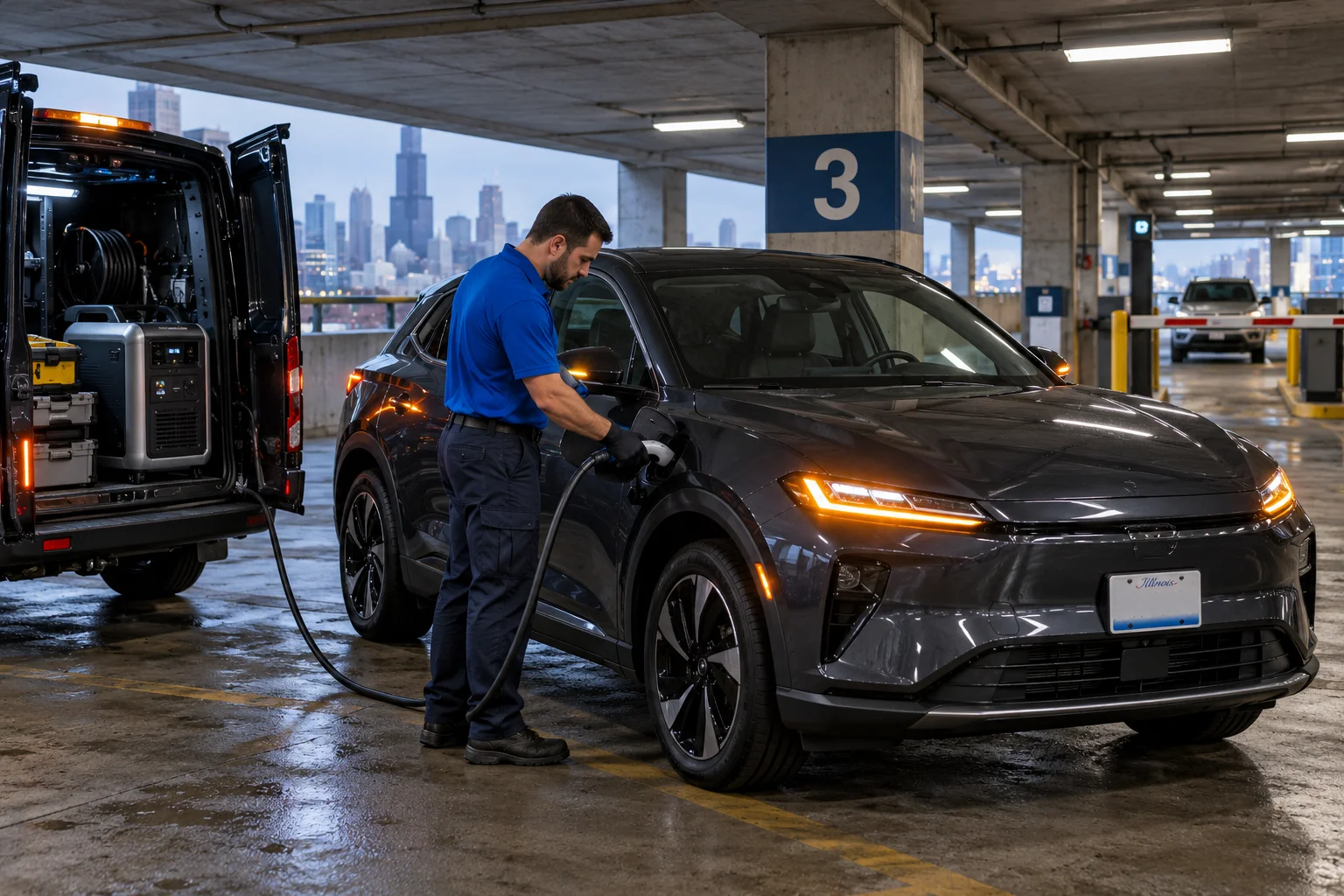
Tell a dead 12V from an empty pack
A dead electric car in a parking garage can fail in different ways. The large traction battery may be empty. The separate low-voltage system may also be unable to wake the vehicle.
Start with what you can observe. Note whether the screens, locks, interior lights, and charge-port controls respond. Check the dashboard and vehicle app for any available messages. Write down the last range or charge reading you saw. Don’t repeatedly press controls when the vehicle isn’t responding.
These observations don’t confirm the cause by themselves. They give the operator useful starting information. A vehicle that wakes normally but shows no usable range presents a different decision from one with dark screens and locked electronic controls.
If the car has power, review its manual before changing drive modes. If it has no power, look for the manual’s instructions on low-voltage access and disabled-vehicle transport. Don’t copy steps from another model. Access points and procedures can differ.
For a Tesla, our guide to a Tesla 12V battery jump explains the referral option. You can also compare common symptoms in our guide to an EV stuck in Park with a dead 12V system.
Don’t treat a low-voltage jump as added driving range. Its purpose and the traction pack’s purpose aren’t interchangeable. The right next step may be a jump, a mobile charge, or transport. The symptoms and vehicle manual should guide that choice.
Check the garage rules before help enters
Call the garage operator before arranging entry. Ask what outside service vehicles may enter and who can authorize access. Garage policies aren’t universal, and we couldn’t confirm one rule covering Chicago-area properties.
Give the garage operator your ticket information, parking level, and stall area. Ask whether a gate attendant, security desk, property manager, or parking office handles disabled vehicles. If the entrance is unattended, ask how an approved operator gets through the gate.
Confirm these points directly with the property:
- Whether an outside roadside or towing operator may enter
- Which entrance the operator must use
- Whether the entry gate needs advance approval
- Whether the operator must check in before entering
- Whether charging equipment faces property restrictions
- Whether the garage has rules about ventilation or vehicle recovery
- Whether parking charges continue while the vehicle remains inside
- Whether another vehicle blocks access to the EV
No universal garage fee, access procedure, or equipment rule could be confirmed from the approved sources. The garage owner or operator sets those details. Ask for the current instructions before booking help.
This matters across Chicagoland. A downtown Chicago garage may have a different entry process from a residential structure in Evanston, Oak Park, or Naperville. Don’t assume that approval from a tenant, hotel desk, or nearby business also covers the parking facility. Confirm it with whoever controls the garage.
Charge Pro CHI can connect you with a licensed, independent local operator. We don’t control the property, open gates, approve equipment, or enter the garage ourselves.
Why clearance and access change the recovery plan
A garage entrance can prevent a suitable service vehicle from reaching your EV. Read the posted clearance sign and share its exact wording. Don’t estimate the height or tell an operator that a vehicle will “probably fit.”
Check every part of the route from the street to your stall. Some garages have separate entrances, internal ramps, gates, turns, or level changes. Report what you can see without walking into vehicle lanes or restricted areas.
Useful access details include:
- The posted clearance at the correct entrance
- Whether the EV is above or below street level
- The level number and stall number
- The nearest elevator, stairwell, or section marker
- Whether the stall faces a wall, column, or parked vehicle
- Whether there is room in front, behind, and beside the EV
- Whether the wheels are turned
- Whether the vehicle can enter Neutral or a transport mode
- Whether the charge port is reachable
Send photos if the operator requests them. Photograph the entrance, clearance sign, gate, level marker, and space around the car. Avoid showing payment details or other private information.
Clearance isn’t the only issue. A vehicle may fit through the entrance but lack room to turn near the stall. An operator may need a different recovery method if the EV sits against a wall or won’t shift out of Park.
Don’t move, drag, or tow the EV based on a general internet instruction. Use the vehicle’s manual and tell the operator the exact year, make, and model. Garage access and manufacturer transport instructions must work together.
Choose a jump, mobile charge, or tow
The correct service depends on the failure and the garage. Our charge, jump, or tow guide can help you sort the basic decision before requesting assistance.
A low-voltage jump may fit when the vehicle can’t wake its controls. The matched operator should follow the correct procedure for that model. Charge Pro CHI doesn’t perform the jump or promise that a jump will solve the underlying problem.
A mobile charge may fit when the traction pack is empty and suitable equipment can reach the car. A typical rescue charge can add 10 to 20 miles of range during 15 to 30 minutes of Level 2 charging. That time describes charging only, not operator arrival. Garage approval, access, and the vehicle’s condition still matter.
A tow may be needed when charging isn’t suitable, the EV won’t accept power, or the vehicle can’t be made ready to drive. Tell the towing operator that the vehicle is electric and may be stuck in Park. Don’t request a standard tow without sharing the exact model and power condition.
Manufacturer instructions can change the transport plan. Tesla says Model 3 Tow Mode is reached through the touchscreen. Without low-voltage power, an external low-voltage supply is needed to use that screen. If Tow Mode can’t be activated, Tesla directs transporters to use self-loading dollies or tire skates. Check the current Tesla Model 3 owner’s manual for the full procedure.
Kia recommends wheel dollies or a flatbed for a disabled EV6. Its manual says the driven wheels must be moved off the ground when the parking brake and gear-change operation are unavailable. The Kia EV6 towing instructions contain the model-specific details.
Ford says a Mustang Mach-E’s Temporary Neutral Mode can be unavailable with a low 12V charge. An external power source may be needed, and Temporary Neutral Mode must not be used for towing.
Chevrolet says the Equinox EV isn’t designed to remain in Neutral for extended periods. It may return to Park automatically and isn’t designed for towing with its wheels on the ground.
These examples aren’t interchangeable. Use the manual for your exact vehicle. For help finding an appropriate local operator, see our EV roadside assistance referral service.
Share the right entrance with the operator
A street address may lead to the building lobby instead of the garage entrance. Share the entrance used by vehicles, not only the property’s mailing address.
Drop a map pin at the garage driveway when possible. Then add plain-language directions. Name the street, nearby intersection, entry lane, and visible sign. If several garages serve one block, explain which entrance reaches your level.
Provide one complete message containing:
- Vehicle year, make, and model
- Current dashboard or app messages
- Last known range or charge reading
- Whether screens, locks, and lights respond
- Whether the EV shifts out of Park
- Garage name or property description
- Vehicle entrance street and map pin
- Posted clearance
- Level, section, row, and stall
- Gate and check-in instructions
- Garage contact or approval status
- Photos of the entrance and vehicle position
Say whether you’ll meet the operator at the entrance. If the garage requires an attendant escort or ticket validation, arrange that with the property. Don’t ask the operator to discover the access process after reaching the wrong gate.
Keep your phone available for questions, but don’t rely on cell service inside the structure. If coverage is poor, agree on a meeting point with the operator and garage staff. Don’t publish or send entry codes beyond the people authorized to receive them.
Charge Pro CHI matches drivers with licensed, independent local EV charging professionals. The operator quotes and bills you directly. We don’t set the price, control garage access, perform the work, or promise an arrival time.
When to call us
Call when your EV needs a mobile charge, a model-appropriate low-voltage jump, or an operator who can assess the recovery options. Confirm the garage entrance, clearance, and property approval before requesting service.
Call us at (708) 412-5005 and we’ll connect you with a local EV rescue operator.