The pack is too low to reach the next stall, and the car is still sitting in a Schaumburg office lot. You can wait for a flatbed, walk a garage looking for an open plug, or book a mobile charge that comes to the bumper. Charge Pro CHI matches you with a licensed local operator who quotes the boost, plugs in, and bills you directly.
What an EV mobile charging service does on site
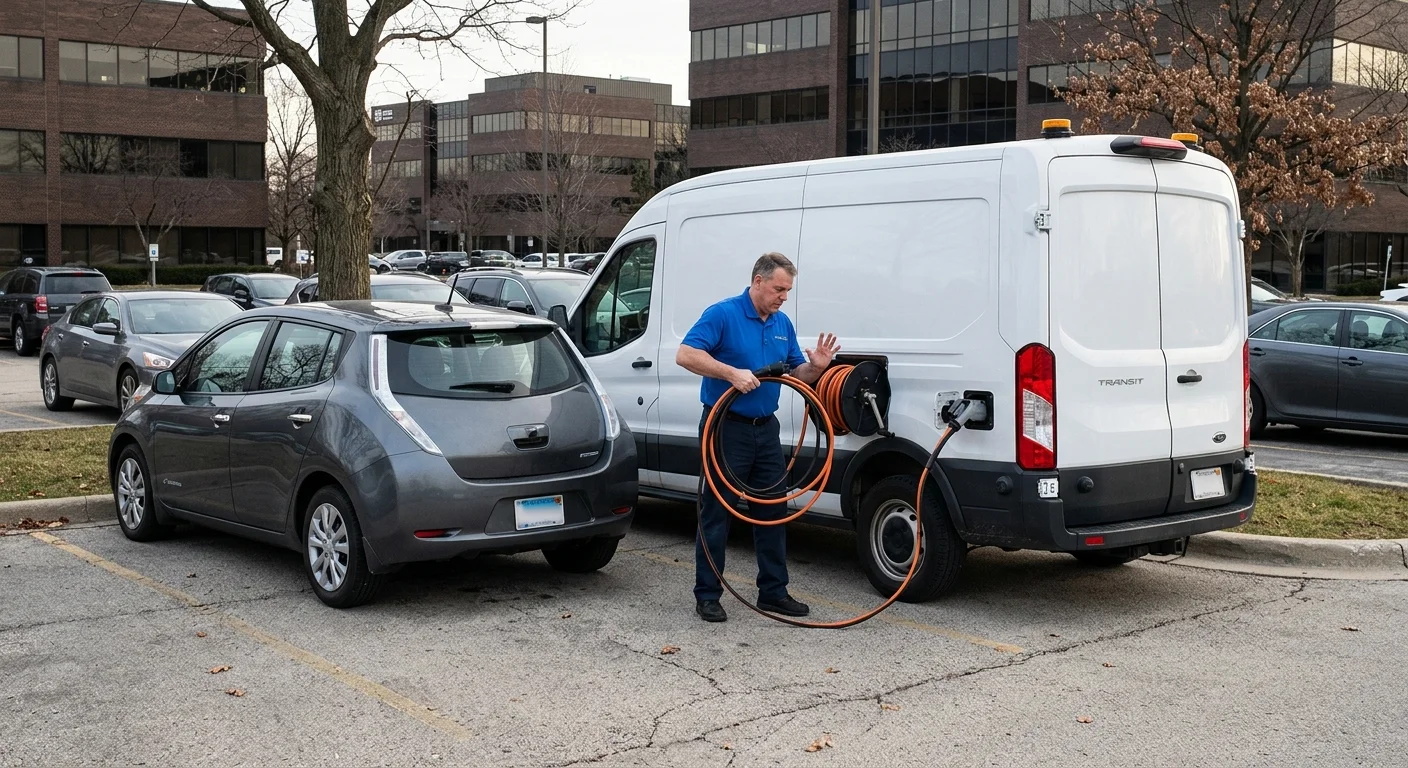
An EV mobile charging service is a rescue, not a fill-up. A licensed independent operator parks next to your car. They confirm the port on your vehicle. Ask them to bring the connector your car uses, J1772 or NACS. They plug in and add enough energy for you to drive to a real charger.
The typical rescue charge is 10 to 20 miles of range in 15 to 30 minutes of Level 2 charging. That window is charging time. It is not an arrival promise. Charge Pro CHI does not own the van and does not run the session. The operator you hire does the work.
You stay with the car. The operator stays with the cable. When the session ends, you unplug, you pay that operator, and you drive. The destination is usually a public stall, a workplace plug, or a home charger you can actually reach.
This is the service you want when the traction pack is low and the car still wakes up. It is not a 12-volt jump. A dead 12-volt leaves the car dark even if the big pack has miles left. It is not a shop repair. If a charge port is iced shut, a cable is stuck, or the car refuses a session, say that on the call so the operator can tell you whether a boost still makes sense.
If you want the van layout, read how a mobile EV charging truck works. This page is the booking decision. You are choosing a boost at the bumper instead of a tow or a hunt through a garage.
Mobile EV charging roadside assistance is still roadside work. Shoulders on the Kennedy, the Eisenhower, and the Tri-State are live traffic. Stay in the car until the operator is on scene and tells you where to stand. If Illinois State Police or a local department is already there, follow their directions first.
A Level 2 boost versus hunting a public stall
A public stall sounds simpler until you cannot walk there. A Schaumburg office park often has a couple of plugs in a reserved row. Those stalls can be occupied, gated after hours, or limited to employees. You cannot leave a low car in visitor parking and hope the garage charger is open.
Oak Park is a different problem. Census ACS 5-Year 2019-2023 data puts 78.6% of Oak Park housing as built before 1980. A lot of that stock is condos and two-flats with shared lots and no overnight EV circuit. A walk to a garage charger still leaves your car in the lot. A Level 2 boost at the bumper does not require a second driver.
The U.S. Department of Energy’s electric vehicle pages explain home and public charging as the normal pattern. A mobile session is the exception. You use it when the normal pattern broke. The pack ran down, the stall is blocked, or you are on a shoulder with no walkable plug.
Drivers also ask about the 80/20 rule. That rule is a daily charging habit, not a rescue plan. Many owners keep the pack between about 20% and 80% for regular use. They save a 100% charge for a trip. A mobile boost does not fill the pack. It is a short Level 2 session meant to buy 10 to 20 miles. You are not sitting through the slow top of the curve. You are buying enough range to reach a charger you already have in mind.
A walk still wins if the stall is in the same garage, the car can creep there, and the plug is working. Book the mobile ev charging service when the car cannot make that crawl, the stall is reserved, or you would leave the vehicle on an expressway shoulder to go looking.
Where a mobile charge fits in this metro
Chicagoland is not one parking pattern. Charge Pro CHI covers 49 cities and communities in 8 regions. The same low-pack problem looks different in each of them.
Schaumburg is office-park land. Woodfield-area lots, corporate campuses, and hotel decks strand drivers who expected a workplace stall to be free. A mobile charge at the space you already occupy is often cleaner than circling for an employee-only plug.
Oak Park condo lots strand drivers overnight. Older buildings were never wired for Level 2. If the shared lot has no guest charger, a boost at the bumper gets you to a public stall on Harlem or Lake, or into the city, without a flatbed in a tight alley.
Elk Grove Village is warehouse rows and O’Hare cargo. Delivery vans and shift cars sit for hours in lots with no public chargers. A low pack at the end of a route is a job problem, not a road-trip problem. A mobile session at the dock or the employee lot can be the difference between finishing the shift and calling a wrecker into a freight yard.
Expressway shoulders are the fourth common fit. A car that stops on I-90, I-94, I-290, or I-294 cannot hunt a stall. Walking off a shoulder is unsafe. A mobile operator charges in place so you can drive to an exit charger. If the car will not take a charge, out-of-charge recovery is the other path: a recovery move instead of a session.
Naperville, Aurora, and Elgin have newer subdivisions and longer gaps between plugs on arterial roads. Cicero and Berwyn have tight streets and older housing. Coastal North Shore lots along Sheridan are a different crawl from inland lots off the Jane Addams. If you are searching mobile EV charging near me in Chicagoland, match the place you are actually sitting, not a downtown map pin.
A mobile charge fits when you can name a charger within that 10 to 20 mile window and the car still accepts a plug. It does not fit when you need a shop, a 12-volt diagnosis, or a tow into a service bay.
What a quote usually includes, and what it does not
Charge Pro CHI sets no prices. The independent operator quotes you and bills you. Confirm the number, the connector, and the location fee before you pay. A published brand rate would be a guess, and we will not invent one.
Ask the operator to say what the quote covers. A typical mobile EV charging service quote is built around the callout and the energy they plan to put in. Location matters. A suburban office stall is a different stop than a warehouse row or an expressway shoulder. Night, weather, and whether they need a police or property escort can change the quote. None of those add-ons have a verified metro average in our records, so treat every extra as something to confirm on the call.
The quote usually does not include a tow. It does not include a 12-volt jump unless the operator says it does. It does not include tires, lockouts, or a shop diagnosis. It does not include a full pack fill. If you want the car taken to a charger instead of charged in place, say that. That is a recovery job, not a Level 2 boost.
Insurance is the other common question. Standard auto policies in the United States usually treat charging like fuel. A mobile session is often a personal expense. Some roadside add-ons reimburse a tow to a charger. Whether yours does is a policy question. We could not confirm an Illinois-wide reimbursement rule, and invented claim percentages would not help you. Call your carrier with the policy number in hand.
AAA and other clubs come up the same way. Club coverage varies by plan. Many plans still default to a tow when an EV is out of charge. Do not assume a patrol truck will bring a Level 2 cable. We compared that choice in AAA or a mobile EV charge when the EV dies. Read your card, then decide.
Pay the operator who did the work. Keep the receipt if you plan to ask a club or an insurer about reimbursement later.
Matching you with a local charging operator
Charge Pro CHI is a referral service for Chicagoland. We connect you with licensed, independent local EV charging professionals. We do not hold a trade license, we do not employ the crew, and we do not own charging trucks. You contract with the operator. They quote. They plug in. They bill.
When you call, say where the car is sitting, the make and model, the connector if you know it, and how many miles the display still shows. Say whether you are in a Schaumburg office lot, an Oak Park condo garage, an Elk Grove Village warehouse row, or on a shoulder. That is the information an operator needs to decide if a mobile EV charging session is the right job.
If the car is a brick, say that too. A dark dash is often a 12-volt problem. A pack at zero that will not accept a plug is an out-of-charge recovery problem. The match works better when you describe the car you have, not the service you hoped for.
EV mobile charging services in this metro are still a local trade. The person who shows up is the person you hired through the match. Ask them to confirm insurance on their side, the connector they are bringing, and the range they expect to add. Typical rescue charging remains 10 to 20 miles in 15 to 30 minutes of Level 2 time. If their plan is different, you want to hear that before the cable goes in.
We serve the 49 cities and communities in our Chicagoland footprint. The operator’s availability is theirs to state. We do not publish hours, and we do not promise an arrival window.
When to call us
When the car is stuck in a lot or on a shoulder and you need a Level 2 boost instead of a flatbed, that is a mobile charging call. Call us at (708) 412-5005 and we’ll connect you with a local EV rescue operator. Confirm the operator’s quote before they plug in.