Your EV can stall in a Metra lot off Ridge Road, on Halsted, or on the I-80 edge south of Homewood. A dark screen is often a 12V problem, and an empty range bar is a pack problem. Charge Pro CHI connects you with a licensed local operator who quotes and bills you directly.
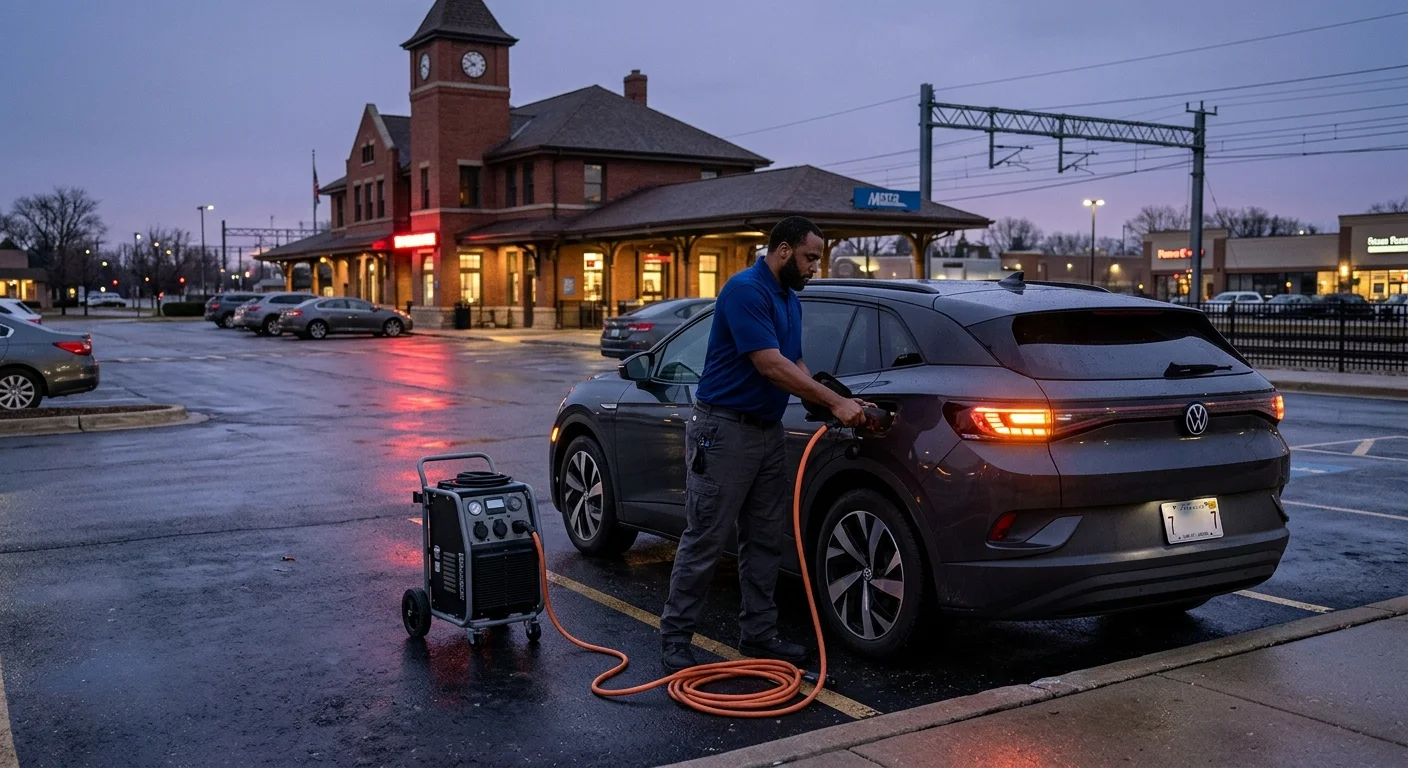
Where Homewood drivers actually stall
Homewood sits in south Cook County with 19,471 residents in the Census ACS 2019-2023 count, and 18,789 in the 2024 estimate. It is a village of older houses, Metra parking, and two interstates on the rim. About 66.5% of the housing was built before 1980. Unheated garages and open rental lots are normal here. That is where electric vehicles in Homewood IL go quiet after a cold night. The 12V battery is usually the first thing to fail in that setting.
Stalls cluster in a few real places. Overnight parking off 183rd Street, Dixie Highway, and the lots behind Ridge Road storefronts. A wall box on a ComEd circuit does nothing when the garage is dark. Errand parking downtown, where cabin heat and short trips chew the last bar. The drive home from the city, when you leave a few percent for the last miles and the south-suburb cold takes it.
This village is not a copy of its neighbors. Median household income here is $96,522. The Hispanic share is 8.0%. Chicago Heights, a few minutes south on Halsted, has a heavier industrial mix and a lower median income. The pattern here is a brick downtown, a Metra Electric District depot, and ramps toward I-80 and I-294. EV roadside help in Chicago Heights covers that town’s grid. This page stays on Homewood’s.
If you are EV stranded in Homewood IL, make the scene safe first. Hazards on. Stay out of Halsted’s through lane. Stay in the car on an interstate shoulder unless you are in immediate danger. Then sort which battery failed. The rest of this page covers that split, the Metra and highway edges, and how a local operator gets you to a plug.
Metra lots, Halsted, and the I-80 edge
The Homewood Metra Electric District lot is a long-dwell trap. Cars sit from the morning train until the evening return. A 12V can sag in that quiet. Cabin preconditioning in January eats pack miles you already spent on I-294. Check the car app before you walk to the platform, not after you find a dark cabin at 6 p.m. If the app will not wake the car, treat it as a 12V job until an operator proves otherwise.
Downtown Ridge Road and the brick blocks around the depot look calm. They are still a stall zone. Shoppers loop. Delivery vans idle. Public plugs, if any, move and fail. Confirm a live stall on PlugShare or the Village of Homewood site before you bet the last miles on it. Do not trust a screenshot from last month. A listed pin is not a working cable.
Halsted is Illinois Route 1 on the east side. It is the run toward Glenwood, Chicago Heights, and the industrial south. Traffic stacks. Heaters stay high. Range can fall faster than the nav predicted. If you stall on Halsted, get the vehicle out of the through lane if you can do it safely. If you cannot, call 911 and stay visible. Do not stand between the car and moving traffic.
The I-80 edge is a different problem. Homewood sits just north of that freight corridor. Ramps dump you onto surface streets that do not always have a charger in sight. An out of charge I-80 Homewood stop is a shoulder job. Keep seatbelts on. Do not walk the travel lane. Illinois State Police handle the interstate. A mobile operator can still reach a legal pull-off once you are clear. For the longer I-80 run west into Will County, read EV rescue on I-80 in Will County.
I-294, the Tri-State Tollway, sits west of the village. Tollway speeds, crosswinds, and a low state of charge do not mix. If you exit toward Kedzie, Dixie Highway, or 183rd Street with a sliver of range, pick a parking lot. Do not spend the last bar hunting a stall from the shoulder.
12V no-start versus an empty pack
Two failures look the same from the sidewalk. The car is quiet. You cannot roll. They are not the same job.
A 12V no-start is a low-voltage problem. Screens stay black. Door handles may not pop. The phone app may not wake the car. The traction pack can still hold tens of miles. A gas-car jump pack on the wrong posts can damage the car. When you call, say you drive an EV. Name Homewood and the street. Ask for a 12V diagnosis, not a random jump. Teslas, Mach-Es, Ioniq 5s, Bolts, and other EVs strand on the 12V in a Homewood cold snap, especially after a long Metra dwell.
An empty pack is a range problem. The display may still work. The car reports zero miles, or a turtle. You cannot limp to a plug. Gas in a can will not help. A typical rescue charge adds 10 to 20 miles of range in 15 to 30 minutes of Level 2 charging. That window is charging time, not a promise of when someone arrives. Charge Pro CHI does not set arrival times.
Roadside help can charge an electric car when the operator brings a mobile Level 2 unit. That is a real option in this metro. It is not a jerry can. If the 12V is dead, the pack may not accept a charge until the low-voltage system wakes. The operator you are connected with sorts that on site.
If your EV runs out of power, do this in order. Make the scene safe. Read the dash or the app. Note the last range number you saw. Check PlugShare for a working public stall you could reach with a short boost. Then call for EV roadside assistance. Ask for a mobile boost first if the car is intact. Ask for a flatbed if you are in a live lane, the car will not go into tow mode, or the pack will not take a charge.
Manufacturer roadside plans exist. Tesla, Hyundai, Ford, and others publish their own rules, and those rules change. Charge Pro CHI does not speak for them. Open the in-car app or the booklet in the glove box. Tesla coverage is not a blank check on an empty pack. Confirm the current terms for your VIN before you assume a free tow. There is no confirmed village or city program that gives every Homewood driver free EV rescue.
South-suburb charging gaps you can check
Chicagoland is not one charging map. Homewood’s public stalls are fewer than a north-shore downtown, and they move. This page will not invent a station count or a mile figure to the next plug. Those numbers go stale. Open PlugShare. Open your car’s map. Check the Village of Homewood website if you are looking at municipal lots. Call the host if a grocery stall looks offline.
South-suburb gaps show up in three ways. A stall is listed and dead. A stall is blocked by a gas pickup. A stall is a slow Level 2 in a lot you cannot sit in after dark. None of those are a reason to gamble the last 4% on Halsted. Mobile EV charging is the tool when the public plug is the problem, not your car.
Home charging fails here too. Two-thirds of the housing stock predates 1980. Shared laundry rooms steal circuits. Landlords do not always allow a 240V drop. Unheated rental parking is the winter version of that gap. You plug into a 120V household outlet, the pack barely moves, and a ComEd outage overnight zeros the plan. If the block is dark, report it to ComEd. Do not sit in a closed garage with a generator. If the wall box is dead and you need to leave, a mobile operator can add enough range to reach a working public stall you have already confirmed.
Chicago Heights to the south and Calumet City to the east have their own patterns: freight, older lots, different street grids. Homewood’s mix is Metra plus I-80 plus a village downtown. Use the neighbor pages for those towns. Use this one for Ridge Road, Halsted, the depot lot, and the interstate edge.
The U.S. Department of Energy keeps national EV basics if you want a primer on charging levels. Local stall status still has to come from a live map, not a brochure.
How a local operator gets you to a plug
Charge Pro CHI is a referral service. It matches you with a licensed, independent local operator. It does not roll a truck. It does not own a fleet. It does not hold a trade license. It does not set a price. The operator quotes you. You pay that operator. That is the whole model.
Here is the usual sequence. You call and describe Homewood, the street, and the failure. Metra lot, Ridge Road, Halsted, I-80 ramp, unheated garage: say the actual place. Say whether screens are black or the range is at zero. Say the make. The operator decides between a 12V wake, a Level 2 rescue charge, or a flatbed. Many EVs need a flatbed if they must be towed. Towing on the drive wheels can damage the motor. Do not let a random hook-and-go treat it like a Civic.
If the operator brings a mobile charger, they connect to your inlet and add a short-range boost. The goal is a working plug you already checked, or home if that circuit is live. It is not a full 0-to-100 session on the shoulder. Fifteen to thirty minutes of Level 2 charging is the typical on-site window for 10 to 20 miles. Weather, inlet type, and pack temperature change that. The operator on site is the one who can speak to your car.
If a boost will not work, the operator tows to a charger or a shop you name. Confirm the destination is open and has a live stall. A closed dealer lot at 9 p.m. is a second strand. For the equipment that shows up, how a mobile EV charging truck works walks the van without turning this page into a catalog.
Keep the scene safe while you wait. Hazards. Soft shoulder if you have one. Kids on the curb side, not the Halsted side. On I-80, stay in the vehicle unless you are in immediate danger. Call 911 first if you are in a live lane.
When to call us
Call when the 12V will not wake the car, the pack is empty, or you are sitting in a Homewood Metra lot, on Halsted, or off an I-80 ramp with nowhere to plug in. A local operator can jump the 12V, add a short Level 2 boost, or arrange a flatbed. Call us at (708) 412-5005 and we’ll connect you with a local EV rescue operator.