The pack hits zero in a Yorktown stall, or the 12V dies in a condo lot west of downtown, and the car will not wake. Lombard sits on I-88 and I-355, so a dead EV is often on a tollway shoulder, a Roosevelt Road curb, or a dark parking deck. Charge Pro CHI connects you with a licensed local operator for emergency EV roadside assistance. The operator quotes the job, does the work, and bills you.
Where Lombard drivers actually stall
Lombard is a DuPage village of 44,490 people on the Census Bureau’s 2024 estimate, and 43,722 on the ACS 2019-2023 count. Drivers here stall on Highland Avenue after an errand, on Roosevelt Road (Illinois 38) heading toward Villa Park, on St. Charles Road west of downtown, and in lots that never had a 240-volt stall.
About 48.6% of Lombard housing was built before 1980. That stock is ranch homes, small condos, and walk-up buildings with shared lots. Many of those lots have a visitor outlet, or none. Median household income is $97,253. Households bought EVs anyway. The car still lives in a stall poured for a gas sedan.
The commute is west-suburban. I-88 sits on the south edge. I-355 sits on the east. Roosevelt is the surface cut toward the city. You leave with enough indicated range, sit in tollway traffic, run cabin heat, and arrive near Main Street with a warning you did not have in Naperville. The last miles disappear on Butterfield Road, not on a Loop grid.
Downtown around the Metra Union Pacific West station feels close to everything. It is still a dead car if you cannot reach a working public plug. Confirm live stalls on PlugShare and on the Village of Lombard site before you roll toward one. Listings move. A stall that worked last month may be down tonight.
If the car died in Wheaton, the Wheaton roadside note matches that downtown and that Metra walk. If you stopped south of the Reagan, the Downers Grove mix of lots and ramps is closer. Lombard’s pattern is mall parking, condo decks, and those two tollways.
Hispanic or Latino share here is 13.2% on the same ACS tables. Neighbors still call in the same way: pin drop, pack or 12V, can the car creep. This page is the English rescue note for that call.
Yorktown lots, I-88, and I-355 shoulders
Yorktown Center sits at the south end of Lombard, off Highland and Butterfield, a short hop from I-88. It is a long-dwell lot. You shop, you eat, the car sits. In January the pack sags. On a wet evening the lot looks bright and you still cannot leave. An EV stranded at Yorktown is a parking-lot rescue. Hazards on. Stay with the car if you can. Tell the operator which entrance you used, Highland or Butterfield, and the nearest storefront wall. Do not send them hunting across the whole center.
I-88, the Reagan Memorial Tollway, is the harder pad. Shoulders are narrow next to a mall lot. Trucks run that corridor between the western suburbs and the city. If the car will still creep, get off at Highland if you can reach it. An out of charge stall on the Reagan is live traffic. Set hazards. Stay out of the travel lanes. Do not walk the shoulder toward a plaza you cannot actually see. Follow what the dash and anyone directing traffic on scene tell you. We do not invent a mile marker.
I-355, the Veterans Memorial Tollway, clips the east side of this village and feeds Elmhurst and Downers Grove. Ramps stack. A stall on an I-355 shoulder has the same first rule: get onto pavement that is not a travel lane. If you can roll to a frontage road or a lot, do that. Model Y drivers who die toward Elmhurst hit a different downtown and a different set of lots. The boost itself is the same idea: add enough range to leave the shoulder.
A mobile operator would rather work in a Yorktown stall than on a tollway. Say the place in plain words. Highland Avenue. Roosevelt. The I-88 shoulder, eastbound or westbound. A ramp to I-355. “I’m in Lombard” is not a location. A pin in the map app is.
If you can still move a few hundred feet, a lot off Highland or a Yorktown stall is the better place to wait. The car is easier to see. Other drivers are not closing at highway speed. That is true in a DuPage EV rescue on either tollway.
Condo parking with no overnight charger
West of downtown Lombard, along St. Charles Road and the streets off Main, a lot of people park in condo lots and small apartment courts. Assigned stalls. No overnight charger. Guest parking that is not yours after posted hours. You plug into a 120-volt outlet if the association allows it, and you wake up with a third of the range you wanted.
That is how a west-suburb EV actually lives here. It is a painted stall and a shared panel that was never sized for Level 2. About half the housing stock predates 1980. Retrofits happen one board meeting at a time. Until that vote lands, the car charges at work, at a public stall you have to hunt, or not at all on a given night.
A ComEd outage in a DuPage winter makes it worse. The lot is dark. The building panel is dead. Your portable cord does nothing. The pack may still have miles, or it may not. If the car will not wake, you need a person with a mobile charger, not another extension cord from a neighbor.
Walk the lot yourself. Read the posted rules. Do not assume the association added EV spots last year. Confirm a public stall on PlugShare before you leave the car for a ride. Village pages lag. Apps lag too. Charge Pro CHI matches you with an operator. The operator does not manage the condo board, and does not install building hardware.
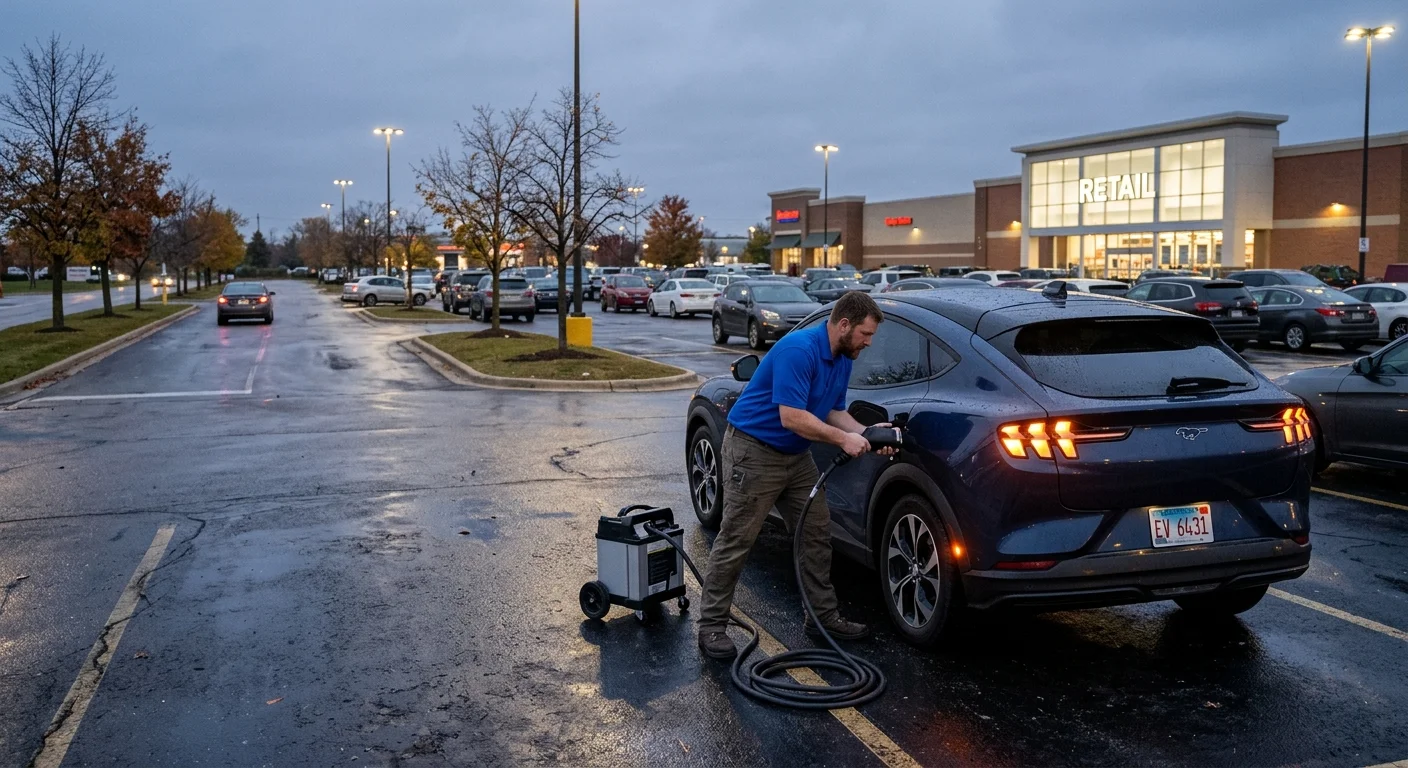
When the car is stuck in that stall, mobile EV charging is the practical path. The operator pulls in, plugs in, and adds enough range to reach a working public charger or your next stop. Typical Level 2 rescue charging, as logged for this brand, is 10 to 20 miles of range in 15 to 30 minutes of charging time. That is charging time. It is not an arrival window.
If the screens are black and the doors will not unlatch, say that when you call. A charge hose will not wake a car whose 12V is dead.
12V no-start versus an empty pack in the west suburbs
West-suburb no-starts split into two jobs. Mixing them up wastes a tow.
An empty traction pack is the one people mean when they search EV roadside assistance Lombard. The car still looks alive. Lights, app, maybe the heat. The dash says zero, or it says you will not make the next exit. You need energy in the high-voltage pack. A mobile Level 2 boost is built for that. A gas can is not. A 12-volt jump is not.
A 12V no-start is the other Lombard winter classic. The car sat in a Yorktown lot or a condo stall. You tap the handle and nothing. Screens black. Doors stubborn. The big pack may still hold fifty miles. The small 12-volt battery that wakes the computers is dead. Cold, long dwell, and an aging 12V unit do this. Jumping the 12V can bring the car back. Charging the pack will not, until those computers are awake.
Tell the operator which one you have. App still talks: treat it as a pack problem until the dash says otherwise. App silent and the car is a brick: start with 12V. Hazard lights that still blink: you have some 12V left. A car that rolled into the stall yesterday and will not unlock this morning: 12V until proven otherwise.
Does ordinary roadside assistance cover EV charging. Read your card. Many auto-club and insurance add-ons still dispatch a tow or a jump written for a gas car. Some will tow an EV to a charger. That is a different job from a mobile charge. Manufacturer programs differ by brand and by year. Check the app or the booklet in the glove box. Charge Pro CHI does not sell a membership and does not speak for those plans.
How much a rescue costs is a question the operator answers. Charge Pro CHI sets no price and does not publish a rate. The person who shows up quotes the work. You pay that person.
How a local operator gets you to the next plug
Once you are matched, the local operator brings a mobile charger to the car. Charge Pro CHI makes the match. You contract with the operator. The licensed, insured pro plugs in, watches the session, and stops when you have enough range to leave.
They want a safe pad: a Yorktown stall, a condo lot, a Roosevelt curb that is not a live lane. On I-88 or I-355 they work from the shoulder only when that is the only option. If you can still roll, a lot off Highland is the better pad.
They add range, not a full charge. The verified typical rescue is 10 to 20 miles in 15 to 30 minutes of Level 2 charging. That is enough to reach a public stall you have already confirmed, or to get home if home is close. It is not a fill-up. The U.S. Department of Energy’s electric vehicle pages explain charging levels if you want the background. Level 2 is the common mobile rescue tool. DC fast charging lives at a station, not on a condo apron.
After the boost, you drive. Check PlugShare again. Confirm the stall is free and working. If the first public plug is down, you still have the miles the operator just put in. Do not burn those miles hunting a second site across DuPage without a live listing.
What you do in the first minutes if the car is already dead: hazards on, stay out of travel lanes, share a pin drop, say pack versus 12V, and say whether the car can creep. Do not sit in an I-355 gore point hoping a plaza is close. Do not let a passerby put jumper cables on the traction pack. The 12V has small posts. The high-voltage pack does not take a gas-station jump.
If the car is damaged, leaking, or in a crash, that is 911. A boost is for a healthy EV that ran out of energy or lost the 12V.
When to call us
A stall at Yorktown, on I-88, on I-355, or in a west-Lombard condo lot is the moment to book a mobile EV rescue operator. Call us at (708) 412-5005 and we’ll connect you with a local EV rescue operator. Share a pin, pack versus 12V, and whether the car can still creep.