The first night below freezing is when a lot of Chicago EVs go silent. The traction pack can still show miles. The small 12V that wakes the car is what often drops out. Check tonight’s low with NWS Chicago at weather.gov/lot before you treat this like another mild week.
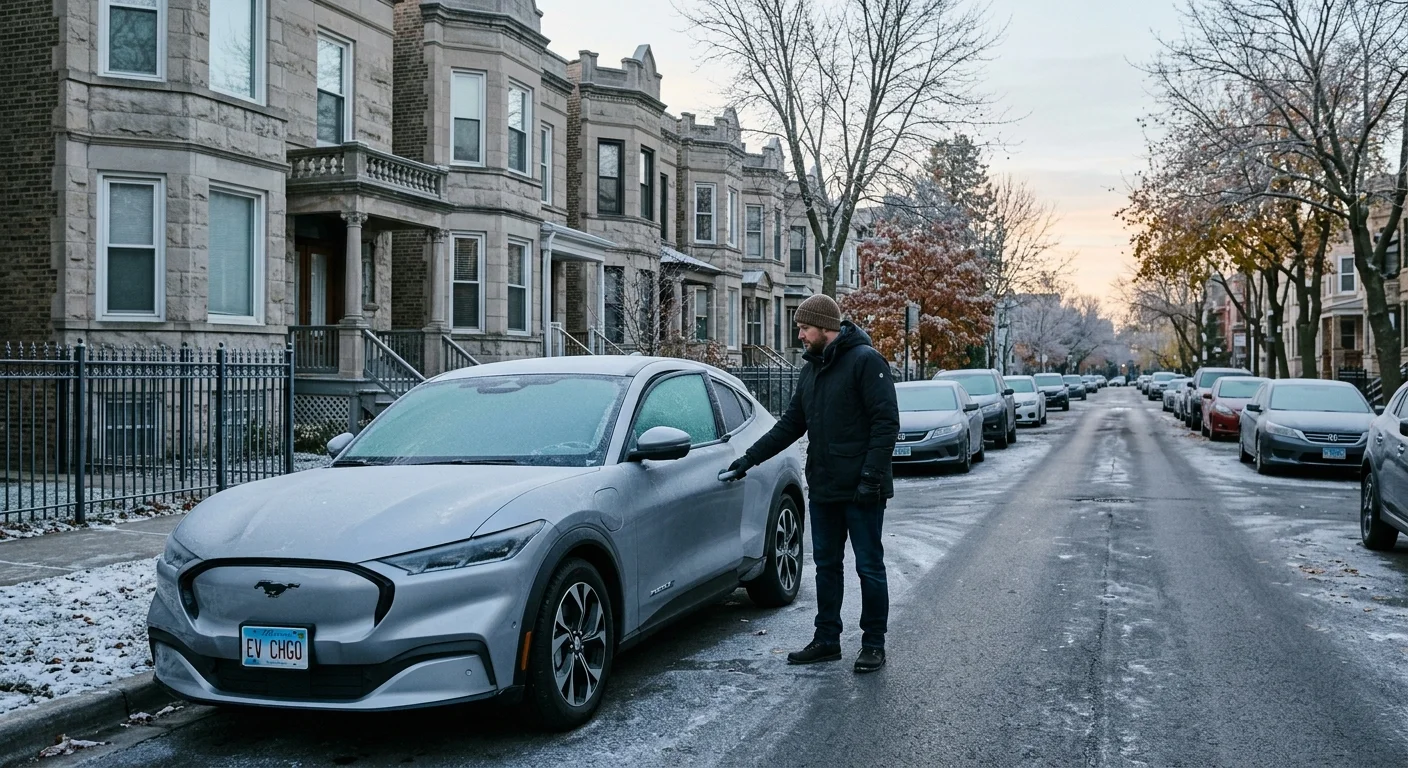
What the first freeze does to a 12V
Every EV still has a small 12-volt battery. It wakes the computers, pops the handles, and tells the high-voltage pack to come online. The big pack does not spin a starter. If the 12V cannot hold voltage, the car acts dead even with range on the display.
The first freeze is a timing problem. Through early fall the 12V still had warm chemistry and shorter nights. One overnight at or below 32°F on a Logan Square curb, a Pilsen side street, or a Hyde Park lakefront block changes that. Cold slows the reaction inside that small battery. A unit already weak from short trips, cabin cameras left on, or age can sag past the point where the car will boot.
This is not a gas-car no-start. There is no thick oil and no starter to grind. If an EV goes quiet after the first freeze, the usual causes are a sagging 12V, a charge-port door frozen shut, or a pack that looks empty after cabin heat. The symptoms of a dead EV 12V look like a dark screen, a handle that will not present, or an app that cannot find the car.
A deeply discharged lead-acid 12V can freeze in hard cold. Do not assume yours is frozen just because the car is quiet. Do not thaw it with a hair dryer, a space heater, or boiling water. If the case looks swollen or cracked, leave it and get a licensed operator. Some newer models use a lithium 12V. Those still lose voltage in the cold, just in a different way. Your owner’s manual is the source for which chemistry you have and where any jump posts sit. If the manual does not show a jump point, do not guess under the frunk liner.
People expect the big pack to keep the 12V topped up overnight. It can, through a DC-DC converter, when the car is awake. When the car is asleep on a freeze night, that converter is not running a steady charge. Small draws keep ticking: clocks, alarms, scheduled preconditioning, and phones left plugged in. The first freeze is when that gap shows up on the street.
There is no single “too cold for an EV” number we can publish as fact. EVs run through Chicago winters every year. Manufacturers print low-temperature operating ranges in the owner’s manual. Confirm that figure there. Confirm tonight’s air temperature with NWS Chicago. Lake-effect wind off Lake Michigan on the North Shore can make a 30°F reading feel much harder on a parked car than the same number in an inland garage.
Street parking versus an unheated garage
Where the car slept matters as much as the thermometer. A Tesla, Ioniq, Equinox EV, or Mach-E on permit parking in Lincoln Park, Bridgeport, or Rogers Park sits in moving air all night. Wind off the lake strips heat from the body, the 12V, and the charge-port door. Frost on the windshield is the clue you already missed. By dawn the latch motors and the 12V are the coldest they will be all day.
An unheated garage is only a partial shield. A lot of Oak Park and Cicero two-flats still park in detached brick garages with no heat. Berwyn housing looks the same. Those boxes block wind and keep frost off the glass. They do not keep the 12V at summer temperature. ACS 5-Year 2019-2023 figures show 78.6% of Oak Park housing and 90.2% of Cicero housing were built before 1980. That stock is alleys, brick, and unheated stalls, not a conditioned attached garage in a newer Naperville subdivision.
A heated attached garage in Schaumburg, Wheaton, or Plainfield is a different night. The car never sees the freeze the same way. The first-freeze no-start cluster in Chicagoland tracks street parking and cold garages, not heated stalls. If you split time between a downtown curb and a suburban garage, the curb night is the one that catches you.
Charge-port doors freeze on both setups when melt from the day refreezes after sunset. Ice in the latch is not a dead 12V. It is a door that will not open, so the car will not charge, and in the morning you still have whatever range you parked with. Do not pour hot water on the port. Check the owner’s manual for the approved way to free it. If the 12V is already down, you may not get the port motor to move at all.
Preconditioning while plugged in is the useful habit before a freeze night. The car can warm the cabin and the pack from wall power instead of from the traction battery. That does not charge a 12V that has already failed. It does reduce the overnight drain if the car is still healthy. Plug in if you have a working home outlet. Street parkers in the city often do not. That is why the first freeze hits curb cars first.
Pack range drop versus a true no-start
Cold range loss and a no-start are not the same failure. Mix them up and you call the wrong kind of help.
Range drop is the pack doing less work in the cold, plus cabin heat drawing from the same battery. The car still wakes. The app still connects. Doors still open. You can still put it in drive, even if the estimated miles look ugly. The U.S. Department of Energy keeps general electric vehicle guidance for owners. It will not tell you why this specific car is dark on a Chicago curb. Use it for climate context, not as a diagnosis.
A true no-start after a freeze is a car that will not wake. Screens stay black. Walk-up unlock does nothing. The app times out. You may hear a single click, or nothing. Last night the display still showed tens of miles. This morning it is a brick. That pattern points at the 12V, not an empty pack.
An empty pack still usually lets the 12V run the brains, at least for a while. You can often open the car, see a zero-mile or very low estimate, and get a “charge now” message. That is an energy problem. A local operator can bring a Level 2 rescue charge. Typical on-site charging in our network notes is 10 to 20 miles of range in 15 to 30 minutes of Level 2 charging. That is charging time once the session starts, not a promise about when someone arrives.
If the 12V is dead, you cannot start a charge session, you cannot precondition, and you may not get the door open. Jumping or supporting the 12V is the first job. Charging the pack comes after the car will talk to a connector. Tesla owners sometimes see this a day or two early. Warning signs before a Tesla 12V no-start include odd app disconnects, random 12V or low-voltage alerts, and handles that hesitate. Those are worth acting on before the first freeze night, not after you are already late on the Kennedy.
Do not keep pressing start. Repeated wake attempts pull more from a 12V that is already on the floor. One calm check of the app, the doors, and the charge port is enough to know which problem you have.
Checks to run before you call anyone
Stand still and sort the car before you call anyone. You are looking for three things: will it wake, will it open, and is the pack actually empty.
Open the manufacturer app. If the car reports a healthy state of charge and still will not wake at the curb, treat it as a 12V problem. If the app shows a very low pack and the car still opens, treat it as an energy problem. If the app cannot reach the car at all, assume the 12V is down until a licensed operator proves otherwise.
Try the door. Electronic latches need 12V. A dead 12V is a common reason an electric car will not open after a freeze. Most fobs hide a mechanical key. The owner’s manual shows where it is and which door it works on. That procedure is model-specific. If it is not in the manual in your glovebox or the in-car copy, do not pry the handle. You can damage the latch and still be locked out.
Look at the charge-port door and the wiper park. Frost there means the car sat in air at or below freezing, which you already suspected. Ice in the port can block a charge even when the 12V is fine. Do not force the door with a screwdriver.
Check nearby weather, not a national headline. NWS Chicago is the local office. If the overnight low in the city, on the lakefront, or inland in DuPage was at or below freezing, the first-freeze pattern fits. Inland McHenry and Will County can freeze on a night when the Loop still sits a degree above. Your block is the one that counts.
Read the 12V jump section of the owner’s manual before anyone puts clamps on the car. Jump posts, if they exist, are not in the same place as a gas battery. Some EVs want a 12V support, not a conventional jump. If the manual does not show a post, say so when you call. A local operator who works EVs will not invent a clamp point.
Skip the gas-car folklore. Thinner oil, block heaters, and long idle warm-ups do not apply. Do not keep a portable jump pack on the 12V overnight unless the manufacturer says that is allowed. Do not wrap the 12V in a blanket you have to fish out of a live high-voltage bay.
If the car opens, the display lights, and the estimate is near zero, you need energy, not a 12V jump. If it stays dark, you need the 12V addressed first.
When a local 12V jump is the right call
A local 12V jump is the right call when the car slept through the first freeze, looked fine last night, and will not wake this morning. Street parking in the city and unheated Oak Park or Cicero garages are the usual setting. The pack is not the patient. The 12V is.
Charge Pro CHI does not jump batteries, own trucks, or send a crew. We connect you with a licensed, independent local operator. That operator quotes you, does the work, and bills you. If the car is a Tesla, a Tesla 12V battery jump is the service to ask for. If you are not sure whether you need a 12V support, a range boost, or both, emergency EV roadside assistance is the broader match. Tell the operator it is the first freeze morning, whether you are on a curb or in an unheated garage, and what the app did.
A jump that brings the car back is not always the end. Cold 12Vs that already sagged once often sag again. If it dies a second time after a short drive to work, the 12V may need replacement, not another support. That is a shop or mobile-electrical decision for the operator, not a promise from us.
If the 12V comes up and the pack is actually empty, then you need charging, not another clamp. A mobile Level 2 session is the usual next step in that case. Again, the operator on scene decides, and the driver pays that operator.
Have the VIN, the exact block, and the owner’s-manual jump page ready. Alleys behind greystones, permit-only sides of Logan Boulevard, and lakefront lots all change how an operator can stage. Say if the doors will not open. Say if you already tried the mechanical key. That keeps the visit from turning into a lockout plus a 12V job.
The first freeze will not be the last cold night. Once NWS Chicago has posted a freeze, treat every overnight street park like this one. Plug in if you can. Precondition from the wall. Watch the app for 12V or low-voltage alerts. The quiet morning on the curb is the expensive way to learn the pattern.
When to call us
Call when the car will not wake after a freeze night, the app is dead, or the doors will not open, and you need a licensed local operator for a 12V support or a range boost. Call us at (708) 412-5005 and we’ll connect you with a local EV rescue operator.