Your battery indicator reaches zero while snow is still falling. At that point, the decision isn’t about ordinary winter range loss. You need to describe the vehicle’s condition, share an exact location, and choose between charging and transport.
Move out of traffic if the vehicle still responds
If the EV still accepts driver input, look for a safer stopping position. Don’t attempt a complicated maneuver through snow or across moving traffic. Follow posted directions and the instructions shown by your vehicle.
A stalled EV blocking a travel lane needs emergency attention. Contact emergency services and explain that an electric vehicle has lost propulsion. Tell them whether you’re inside the car, whether the vehicle responds, and which lane is blocked.
Don’t push the car through an active roadway. Don’t attach a strap or let another driver improvise a tow. The correct movement procedure depends on the vehicle and its available power. Check the owner’s manual before anyone tries to roll, drag, or load it.
This distinction matters for several common EVs. Tesla says a Model 3 enters Tow Mode through its touchscreen. Without low-voltage power, an external low-voltage supply is needed to use that screen. If Tow Mode can’t be activated, Tesla directs transporters to use self-loading dollies or tire skates.
Ford says Temporary Neutral Mode in a Mustang Mach-E may be unavailable when the 12V charge is low. An external power source may be needed. Ford also says Temporary Neutral Mode must not be used for towing.
Kia recommends wheel dollies or a flatbed for a disabled EV6. If the parking brake and gear-change operation are unavailable, the driven wheels must be off the ground. Chevrolet says an Equinox EV may return to Park automatically and isn’t designed for towing with its wheels on the ground.
Those instructions aren’t interchangeable. Give the operator your exact year, make, and model before movement begins.
Separate range loss from a dead 12V
An electric car that died in snow may present two different stories. The main battery display may have counted down to zero. Alternatively, the screens, locks, or controls may have stopped responding before the displayed range reached zero.
Don’t guess which battery failed. Report exactly what happened. Useful details include the last range shown, the final warning displayed, whether the screen works, and whether the car shifts. Also mention whether the doors, charge port, or mobile app still respond.
A main pack at zero points toward out-of-charge EV recovery. A dark or unresponsive vehicle may require low-voltage assessment before charging or transport. Our guide to the first freeze and an EV that won’t start explains how a no-start can differ from an empty traction battery.
Don’t treat a 12V procedure as a traction-battery charge. Don’t connect equipment unless your owner’s manual provides the correct process. Each model can have different access points and transport steps.
The approved information for this site doesn’t confirm a universal cold-weather range percentage. It also doesn’t establish that one snowstorm damages an EV battery. Check your vehicle manufacturer’s current documentation for battery warnings, operating limits, and model-specific guidance.
Battery replacement pricing isn’t confirmed in the approved claims ledger either. A roadside shutdown doesn’t establish that the high-voltage battery needs replacement. Ask the manufacturer or a qualified repair facility for diagnosis before considering that expense.
The goal at the roadside is narrower. Identify the visible symptoms, then match the vehicle with the right type of assistance.
Share an exact location in poor visibility
“Somewhere in Chicago” isn’t enough during steady snow. Start with the road name and direction of travel. Add the nearest visible exit, intersection, building, or posted marker. If your map app provides a location pin, share it with the operator.
Name the road carefully. The Kennedy, Dan Ryan, Edens, Eisenhower, and Bishop Ford aren’t the same recovery location. Lower Wacker also needs more detail than a general downtown description. Include the direction you were traveling and any readable sign.
On a neighborhood street, provide the full street name and nearest cross street. Say whether the EV is curbside, in a parking area, or blocking a lane. If it’s in a garage, identify the entrance and the vehicle’s level. Don’t assume the operator can determine your position from the vehicle model or a partial address.
Share the car’s color, year, make, and model. Explain how snow affects its visibility. Mention whether exterior lights work, but don’t claim that working lights make the location safe.
Your location message can follow this order:
- Road or full street name
- Direction of travel
- Nearest exit, cross street, or posted marker
- Lane or parking position
- Vehicle year, make, model, and color
- Whether the screen and controls respond
- Last displayed range or warning
If the vehicle blocks moving traffic, contact emergency services first. Current lane, shoulder, and snow-emergency restrictions aren’t confirmed in this site’s approved claims ledger. Follow posted directions and instructions from public authorities at the scene.
Charge Pro CHI serves Chicagoland through a referral network covering 49 cities and communities across eight regions. Location detail helps us connect you with an appropriate independent local operator.
Choose a mobile boost or a tow
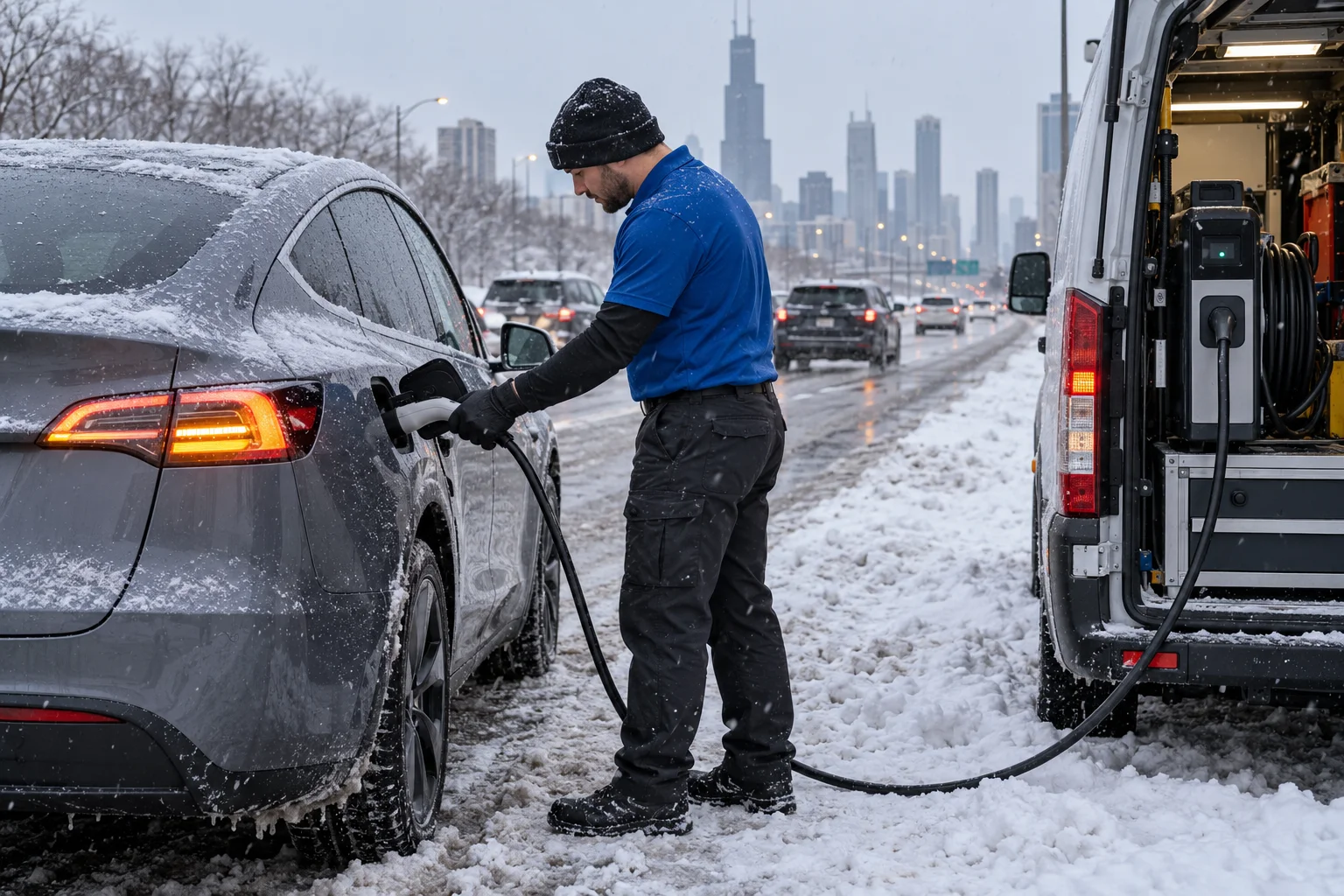
A mobile boost fits when the main pack is empty, the vehicle can accept a charge, and its position permits the operator to work. A tow may fit when the car can’t accept charging, can’t be placed into its required transport mode, or remains in an unsuitable position.
A typical rescue charge can add 10 to 20 miles of range during 15 to 30 minutes of Level 2 charging. That time describes charging only. It isn’t an arrival estimate, and the result isn’t a promise for every vehicle or condition.
The independent operator should confirm compatibility and quote the work. Charge Pro CHI doesn’t set prices, operate charging equipment, or own rescue trucks. The customer contracts with and pays the operator directly.
Before choosing, give the operator four facts:
- The last range or battery reading
- Whether the EV powers on and shifts
- The connector used by the vehicle
- The exact stopping position
A small boost may be useful when the operator confirms that the vehicle can charge where it sits. Mobile EV charging in winter isn’t a repair for every shutdown. A warning, damaged component, inaccessible charge port, or transport limitation may change the plan.
A tow needs model-specific handling. The Tesla Model 3, Mustang Mach-E, Kia EV6, and Chevrolet Equinox EV each have transport limitations documented by their manufacturers. Tell the towing operator that the vehicle is an EV. Ask the operator to review the correct owner’s-manual procedure before loading it.
For a broader comparison, read our guide to what to do when an EV is running low before a stall. It covers the earlier decision point, before the battery reaches zero.
Check current road guidance before waiting
Active snow can change the roadside situation while you wait. Check current official weather and road notices from the National Weather Service Chicago office and the public agency responsible for the road. This site’s approved claims ledger doesn’t contain current storm guidance, closures, or snow-emergency rules.
That means this page can’t confirm whether a particular lane, shoulder, ramp, or parking area is available. It also can’t confirm a current snow total or forecast. Use the latest official notice and follow posted directions at your location.
Tell the operator if public guidance changes your access point. A ramp closure, traffic-control direction, or restricted entrance may require a different meeting location. Don’t move the vehicle unless it responds and the move follows vehicle instructions and directions from authorities.
Keep your status updates factual. Say whether the vehicle remains in the same position. Report any new warning shown on the screen. Tell the operator if emergency personnel arrive or direct you elsewhere.
Don’t rely on a published article for changing road conditions. Check the timestamp on every weather or road update. If you can’t verify that an advisory is current, contact the responsible public authority.
Charge Pro CHI provides referrals, not emergency traffic control. We don’t direct road closures, promise an arrival time, or decide whether a location is safe for roadside work. For vehicle recovery, our emergency EV roadside assistance page explains how we connect drivers with licensed, independent local operators.
If the car blocks a travel lane or creates an immediate emergency, contact emergency services. Give them your exact location, vehicle description, and current condition.
When to call us
Call when your pack reaches zero and an operator must assess a mobile boost or model-appropriate tow. Charge Pro CHI will connect you with a licensed, independent local operator, but doesn’t perform the rescue or promise a response time.
Call us at (708) 412-5005 and we’ll connect you with a local EV rescue operator.