Mobile EV charging in an apartment garage starts with access. Charge Pro CHI can connect you with a licensed, independent local operator, but property staff must let that operator and equipment reach the vehicle.
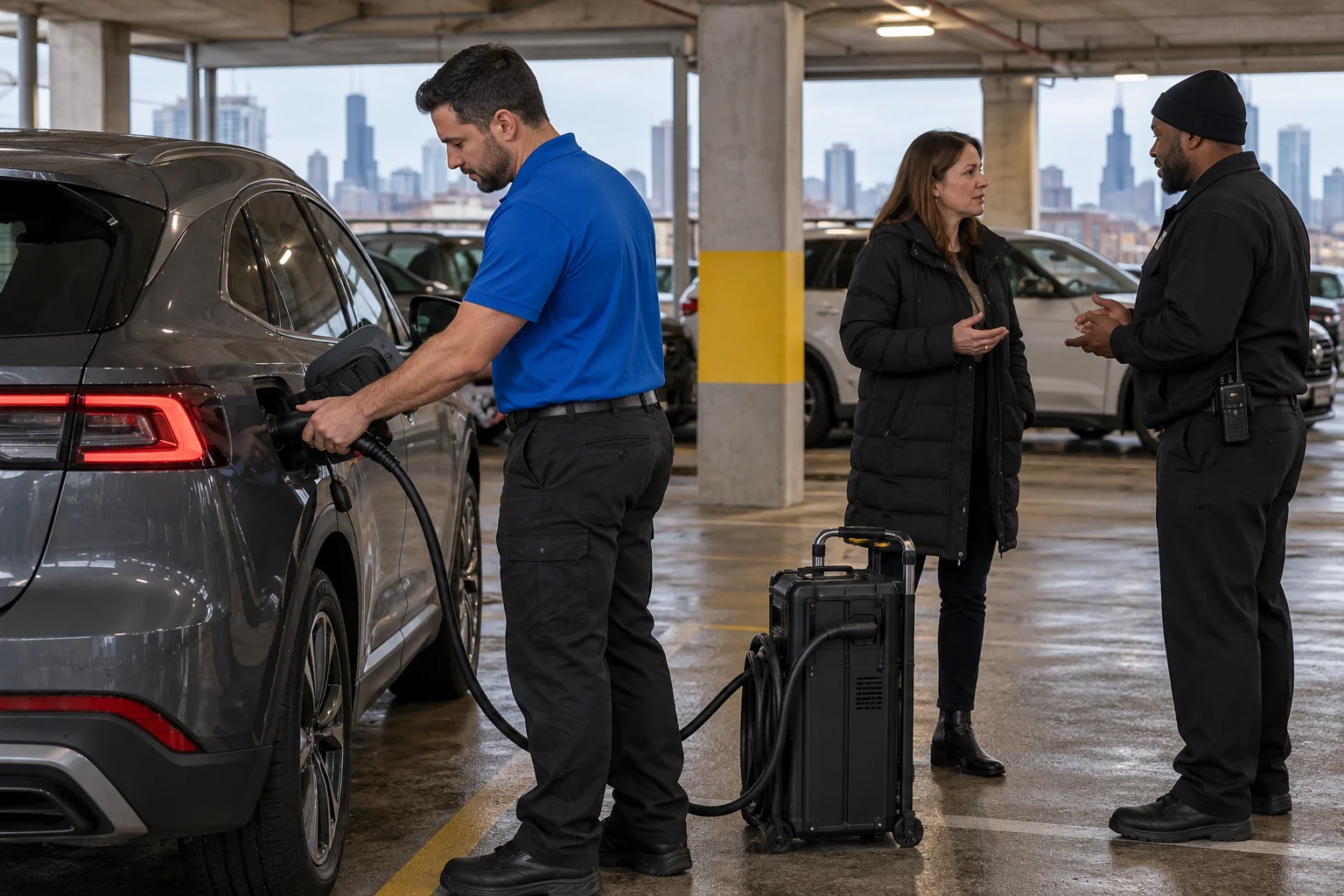
When an apartment EV cannot reach a working plug
An apartment EV out of charge creates a different problem than a roadside stall. The car may be secure in its assigned space, yet unable to reach a working plug. A charging cable from another area may also be prohibited by building management.
Don’t move cords, open electrical rooms, or try an unapproved outlet. Ask management which parking and electrical restrictions apply to your building. Charge Pro CHI doesn’t control those rules, and the matched operator can’t override them.
A mobile EV charging operator may be an option when approved equipment can reach the vehicle. The operator must confirm whether the location, vehicle, and access conditions fit the planned service. Charge Pro CHI makes the referral. The operator enters the property, handles the equipment, quotes the price, and bills you directly.
A typical rescue charge provides 10 to 20 miles of range in 15 to 30 minutes of Level 2 charging. That time describes charging only. It isn’t an arrival estimate or a promise that every vehicle will accept the charge.
The goal is usually enough range to leave the garage and continue to another charging location. It isn’t a permanent charging setup. Drivers comparing those two needs can review our guide to a home setup or mobile boost.
The distinction matters across Chicagoland. Chicago’s 2019-2023 Census data shows 68.6% of its housing was built before 1980. That figure doesn’t describe any particular garage or electrical system. It does show why drivers shouldn’t assume every apartment property supports the same access plan.
Get property approval before an operator enters
Call or message your property contact before arranging garage entry. Depending on your building, that contact might be management, a condominium association representative, security staff, or the person controlling the gate. Confirm who can authorize entry for an outside EV rescue operator.
Describe the request plainly. Your EV is parked in its assigned space and may need a mobile charge. You aren’t asking to install equipment, enter an electrical room, or connect to building power. The matched operator will bring the equipment planned for the service, subject to the operator’s confirmation.
Ask management to confirm the conditions in writing when possible. Useful questions include:
- Can an outside EV rescue operator enter the garage?
- Which entrance should the operator use?
- Does staff need the operator’s name or vehicle details?
- Must a resident or staff member remain present?
- Where may service equipment stop without blocking traffic?
- Are there building rules affecting charging equipment?
- Who can open the gate when the operator arrives?
Don’t promise management that a specific vehicle or equipment setup will fit. Pass any restrictions to the operator and let that professional evaluate them. The matched operator is licensed and insured, but contracts, pricing, and any terms come directly from that operator.
Cicero presents an especially useful housing-access comparison. Census data shows 90.2% of Cicero housing was built before 1980. That doesn’t establish the condition of one building. It supports checking each property instead of assuming that parking access or electrical arrangements match newer developments. Our guide to home EV charging when Cicero housing cannot support it covers the separate long-term charging question.
If management refuses entry, don’t bypass the gate or building rule. Tell the matched operator immediately. The operator can discuss whether another recovery plan should be considered.
Check gates, clearance, and the vehicle location
A dead EV in a gated garage needs more than a street address. The operator must understand how to reach the exact parking space. “Underground garage” doesn’t explain the entrance, turns, ceiling, ramps, or access controls.
Start at the property entrance and trace the route to your car. Note whether the operator must pass a staffed gate, key-card door, call box, loading entrance, or resident-only lane. Tell the operator if an entrance closes automatically. Don’t hold, force, or disable a gate.
Record the posted clearance at the entrance. Don’t estimate it. If separate areas have different posted clearances, report each relevant sign. The operator decides whether the planned service vehicle and equipment can enter.
Next, describe the assigned space. Include the floor, section, space label, nearby column, and the side holding the charge port. Mention tight walls, parked cars, storage cages, steep ramps, or sharp turns. Photos can help, but don’t photograph neighbors or private information unnecessarily.
Also explain where service equipment could stand. A mobile charge may not be practical if the operator can’t position approved equipment near the EV. Never move another resident’s car, block a fire route, or reserve an unauthorized area. Ask management what placement it will allow.
Chicago apartment parking can differ from condo parking in Evanston, Wilmette, or other Inner North Shore communities. The building’s actual rules still control access. Drivers north of Chicago can also review our Inner North Shore mobile charging guide.
Before booking, send the operator the entrance instructions, posted clearance, vehicle location, and management contact process. Clear details help the operator decide whether the garage can be served.
Know when a mobile charge will not solve it
A low displayed range doesn’t prove that adding energy will restore the vehicle. The car may show another warning, reject charging, remain locked, or stay unable to shift. Don’t describe every no-start condition as an empty main battery.
Read the dashboard or app message exactly. Share screenshots with the matched operator when available. Include the vehicle’s make, model, model year, displayed charge level, and whether the screens and locks respond. Don’t clear warnings before recording them.
A typical Level 2 rescue charge is intended to add limited driving range. It isn’t a repair, battery diagnosis, permanent garage charger, or promise that the EV can leave under its own power. The operator must assess whether charging fits the symptoms.
Ask about out-of-charge EV recovery when the main battery appears depleted. If the vehicle won’t power up, won’t accept a connector, or can’t be accessed safely, tell the operator before entry. A different kind of assistance may be needed.
Vehicle-specific transport limits also matter if charging isn’t suitable. Tesla says a Model 3 uses its touchscreen to enter Tow Mode. Without low-voltage power, an external low-voltage supply is needed to use that screen. Tesla directs transporters to use self-loading dollies or tire skates if Tow Mode can’t be activated.
Other models have their own instructions. Ford says a Mustang Mach-E’s Temporary Neutral Mode can be unavailable when the 12V charge is low. An external power source may be needed, and Temporary Neutral Mode must not be used for towing. Check the owner’s manual for your exact vehicle and give its instructions to the recovery professional.
Don’t try to improvise a tow or drag the EV from its space. Let the appropriate operator determine the next step.
Prepare details for the matched operator
Gather the important facts before requesting EV charging help in apartment parking. This avoids vague descriptions and lets the operator evaluate the garage before entering.
Start with the vehicle:
- Make, model, and model year
- Displayed charge level or range
- Exact dashboard or app messages
- Whether screens, doors, and locks respond
- Charge-port location and whether it opens
- Whether the vehicle is in Park
- Any owner’s-manual instructions already reviewed
Then document the property:
- Full service address
- Garage entrance location
- Floor, section, and assigned space label
- Posted height clearance
- Gate, call-box, or key-card process
- Approved equipment position
- Management contact and entry approval
- Restrictions provided by building staff
Tell the operator if your car is parked nose-in against a wall. Mention a neighboring car close to the charge port. Include any concrete column, storage cage, or narrow lane affecting access. Don’t move property or cross into another assigned space without permission.
Ask the operator for the quoted price and service terms before agreeing. Charge Pro CHI doesn’t set prices, collect payment for the operator, or give warranties. You contract with and pay the independent professional directly.
Confirm what the operator needs from property staff. Management may want identity or vehicle information before opening a gate. Share only the information requested for authorized access. If the property changes its decision, update the operator before the visit.
For a general explanation of EVs and charging, see the U.S. Department of Energy’s electric vehicle overview. For the immediate garage problem, the matched operator needs your vehicle symptoms and the building’s confirmed access conditions.
When to call us
Call when an apartment or condo EV can’t reach a working plug, management has approved access, and a mobile charging operator needs to assess the location. Charge Pro CHI will make the referral, while the independent operator confirms service suitability, terms, and price.
Call us at (708) 412-5005 and we’ll connect you with a local EV rescue operator.