The Bolt on 26th Street sits dark at the curb. The Equinox EV in a Cermak rental lot will not wake. That is a non-Tesla stall in Cicero, and the port, the parking, and the missing home plug all shape what happens next.
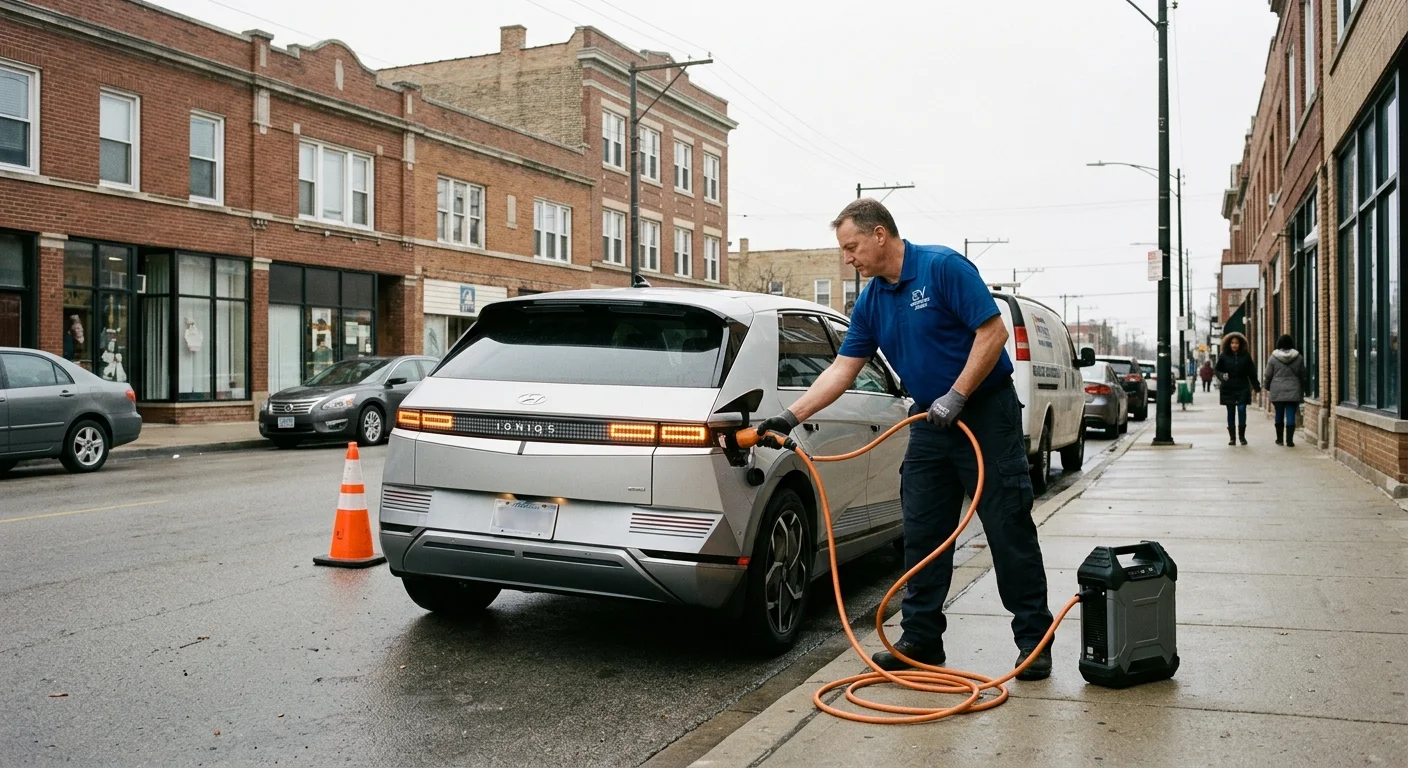
Why a non-Tesla stall in Cicero is different
Cicero is an inner-belt Cook County town of brick two-flats, storefronts, and street parking. The U.S. Census Bureau’s ACS 5-Year 2019-2023 count puts the population at 83,223. The 2024 Population Estimates Program figure is 82,090. Hispanic or Latino residents make up 88.8 percent of that ACS count. Housing built before 1980 is 90.2 percent. That last number is the one that hits an EV. Pre-1980 two-flats rarely came with a garage circuit you can plug a Chevy Bolt, Equinox EV, Hyundai Ioniq, Volkswagen ID.4, or Ford Mustang Mach-E into overnight.
A Tesla inlet and a CCS inlet are different jobs. Tesla cars use NACS at the port. Many non-Tesla EVs still use CCS Combo 1. Some newer non-Tesla models ship with NACS. The car in front of you on Cermak tells you which. A North Shore driveway with a wall box does not describe this town. Here the car lives on the street, in a tight alley, or in a paid lot behind a shop. When range hits zero, there is often no cord in the building and no overnight post in the lot.
This page is for those cars in this town. Metro-wide non-Tesla EV rescue in Chicagoland covers the wider map. Our EV roadside help in Cicero guide covers stalls of every brand. The work here is narrower: Bolt, Equinox EV, Ioniq, ID.4, Mach-E, and similar CCS or NACS non-Tesla cars that die on Cermak, 26th Street, Cicero Avenue, or a rental lot with no charger on the wall.
Charge Pro CHI is a referral service. We connect you with a licensed, independent local operator. We do not charge the car, jump the 12V, or roll a branded truck. The operator you are matched with quotes the job, does the work, and bills you directly.
Cermak Road is the commercial spine. 26th Street is the other daily run. Pink Line riders leave cars on side streets and in small lots, then come back to a silent dash. Inner-belt blocks are short. Alleys are tight. A rescue that works in a Park Ridge driveway still has to fit here, on a curb with buses and double-parked deliveries. Name the street. Name the car. That is how a Cicero non-Tesla stall gets a match that can actually plug in.
CCS, NACS adapters, and what the truck needs
Look at the charge inlet before you call. CCS Combo 1 is the large DC combo port on a lot of non-Tesla EVs sold in this country. NACS is the smaller Tesla-style inlet. Some non-Tesla cars now use NACS from the factory. Others still use CCS. A few cars can take a DC adapter if the owner’s manual lists that adapter by name.
The operator’s truck has to match that inlet. Charge Pro CHI does not own an adapter fleet. The matched local operator brings the cable their public spec lists. If your car needs an adapter, that adapter has to appear in two places: your owner’s manual, and the operator’s published equipment list. If it is missing from either one, compatibility could not be confirmed. Do not assume a puck in the glove box will work on a mobile Level 2 lead. Confirm it.
The U.S. Department of Energy keeps a plain overview of how electric vehicles charge. Charging levels matter on the curb. A typical mobile rescue on this network is a Level 2 session that adds 10 to 20 miles of range in 15 to 30 minutes of charging time. That is time on the cable. It is not an arrival window. It is enough to get off 26th Street and reach a destination charger or a home plug if you have one.
Tell the operator the make, model, year, and what the port looks like. A Chevy Bolt, a Ford Mustang Mach-E, a Hyundai Ioniq 5, and a VW ID.4 do not all take the same lead. Year-to-year port changes happen. The operator confirms the hardware on their end. Non-Tesla EV rescue is the service path for those matches.
Leave the high-voltage pack alone. You can read the dash, the key fob, and the charge-port door. You cannot improvise a DC adapter on Cermak. If the port is iced, packed with slush, or the latch will not release, say that on the call. The operator decides what they can open on site. If the manual is silent on a given adapter, treat that adapter as unconfirmed. Guessing at the inlet is how a truck shows up with the wrong gun.
Two-flats, Cermak lots, and no home plug
Most of Cicero’s housing stock predates 1980. Two-flats on the numbered streets share a narrow gangway and a small rear lot. Street parking on 26th Street and along Cermak Road is the daily pattern. Rental cars and shopper lots behind the commercial strip often have no overnight charger on a post. When the pack is empty, there is no Level 2 cord waiting in a garage.
That changes the rescue. The operator needs a legal place to stand the truck and reach the inlet. A car nosed against a two-flat’s rear wall may need to be moved a few feet if the owner and the property allow it. A stall in a Cermak customer lot needs the lot owner’s okay before a mobile charger occupies a space. We do not set those rules. The property does. The operator works inside them.
Home charging in this housing is its own problem. Older fuse boxes, shared meters, and landlords who never wired a 240-volt circuit are common in pre-1980 brick. We wrote about that separately in home EV charging when Cicero housing cannot. A mobile Level 2 boost does not replace a wall box. It gets the car to a place that can take a plug, or far enough to finish the day.
Give a clear pin on the map. “Cermak and Cicero” is a start. A stall number, a store name, or the two-flat’s address is better. Say whether the car is on the street, in an alley, or behind a gate. Say if the charge door faces the curb or the building. Tight inner-belt blocks leave little room for a long cable. A Bolt parked nose-in under a rear deck can hide the port from the alley. Say that up front.
Do not sit in a travel lane on Cermak or 26th if you can still creep to a legal space. Hazards on. If the car is fully dead in traffic, call 911 for a travel-lane hazard. A rescue operator is not a police tow. Cicero Avenue, Laramie, and the numbered cross streets fill up after shift change. A precise location saves the operator a loop around the block.
12V no-start versus an empty pack
Two different failures look like a dead EV. The traction pack can be empty. The 12-volt auxiliary battery can also be flat. Many EVs will not close contactors or wake the dash when the 12V is gone, even if the big pack still holds range.
An empty pack usually still shows a car that powered down on purpose. You saw the range fall. The display warned you. The car may still unlock and show zero miles. A 12V no-start often looks like a brick. No dash. No unlock. No charge-port door. The fob clicks and nothing moves. Those two stories need different tools on the truck.
A 12V jump is a low-voltage service. An empty-pack rescue is a Level 2 energy transfer (or DC, if the operator’s public spec lists DC). Mixing them wastes the call. Tell the operator what the dash did in the last hour, whether the car drove this morning, and whether you have been plugging in at all. On a Cicero street car that never sees a home plug, an empty pack is a common path. After a hard freeze, a 12V no-start shows up on cars that sat for days in a lot.
Do not open the high-voltage orange cabling. Do not crawl under a two-flat to find a hidden 12V post unless the owner’s manual shows you a marked jump point. If the manual is not in the car, wait for the operator. Emergency EV roadside assistance is the broader match when you are not sure which battery failed.
A tow is a last step, not a first one. Flatbed only, and only with the operator or a shop that knows how to transport that model. A standard hook on a CCS crossover can damage the car. If the pack is empty and the inlet is sound, a mobile charge is the usual try before a wrecker. If the 12V is the only failure, a pack boost will not wake the car. Say what you see. The operator picks the tool.
How we connect you with a local operator
You call Charge Pro CHI. We take the location, the car, and the symptom. We match you with a licensed, independent local EV rescue operator who serves Cicero and the inner west Cook County belt. The operator quotes the job. You accept or you don’t. You pay that operator. We set no price.
The pros we connect you with are licensed and insured. Charge Pro CHI holds no trade license, owns no trucks, and employs no crews. We do not promise an arrival window. Anyone who quotes a time is the operator, on their clock, for their truck.
Have this ready: make, model, year, color, exact street, and whether the inlet is CCS or NACS. Say if the dash is alive. Say if the car is on 26th, Cermak, a side street, or a gated lot. Say if you have an adapter in the trunk and whether the manual lists it. That is the whole brief.
If the stall is a Tesla, that is a different match. This page is for non-Tesla EVs. If you are somewhere else in the metro, use the Chicagoland non-Tesla guide. If you need any-brand help in this town, use the Cicero roadside page. The service you want for a Bolt, Ioniq, ID.4, Equinox EV, or Mach-E on these blocks is non-Tesla EV rescue.
Stay with the car if it is safe. Keep hazards on. Keep the charge door clear of slush. When the operator arrives, they confirm the inlet and the 12V versus pack question before they plug in. You contract with them. They bill you. We step out once the match is made.
When to call us
Call when a non-Tesla EV is dead on a Cicero street, a two-flat curb, or a Cermak or 26th Street lot, and you need a licensed local operator to put range back on the pack or wake a flat 12V. Call us at (708) 412-5005 and we’ll connect you with a local EV rescue operator.