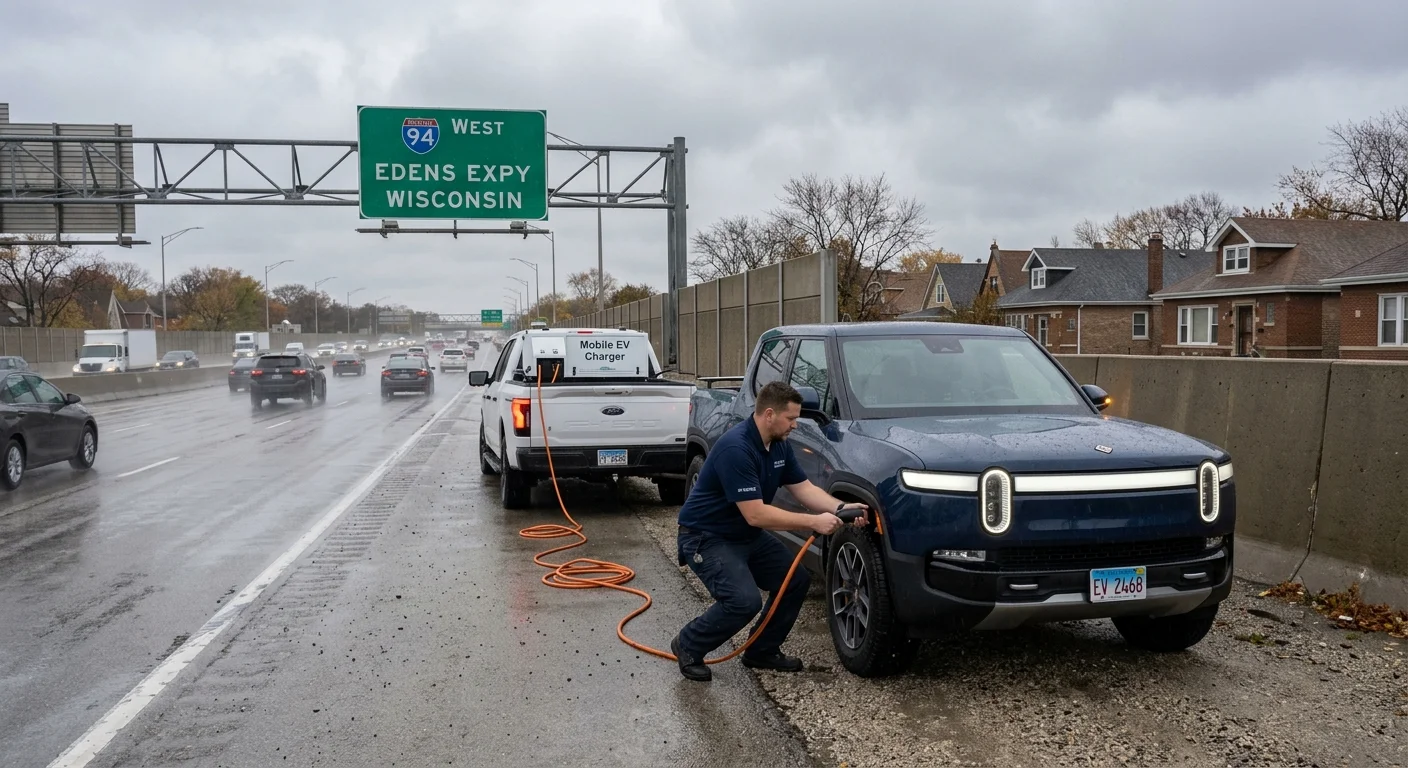
The range hits zero on I-94 between the Kennedy junction and Skokie, and the Edens Expressway has nowhere useful to plug in. You are in a tree-lined trench through Edgebrook, Sauganash, and Lincolnwood, with houses behind the sound wall and traffic still moving. This is an empty-pack problem on a live Cook County expressway, and the next charger lives off an exit, not on the shoulder.
Why the Edens is a hard place to sit with an empty pack
The Edens is the named stretch of I-94 that runs north from the Kennedy through Chicago’s far northwest side, Lincolnwood, and Skokie, then toward Wilmette, Glenview, Northbrook, and the Edens Spur. It is not the Dan Ryan. It is not the Tri-State. Those roads have their own geometry. Copying that advice here puts you in the wrong place.
What makes the Edens hard is how close the neighborhoods sit. Edgebrook and Sauganash press against the right-of-way. Skokie’s ACS 2019-2023 population was 66,427. Wilmette’s was 27,550. Northbrook’s was 34,642. This is a commute spine for the North Shore and the north city, not a freight bypass. Inbound toward the Kennedy stacks up in the morning. Outbound toward Dundee Road and the Spur stacks up at night. An EV that dies in that flow occupies a lane people cannot see until they are on you.
Cold makes it worse. Cabin heat, wet pavement, and a slow crawl at Touhy all pull from the same pack. The U.S. Department of Energy walks through why speed and temperature cut electric range. A Hyundai, Ford, Rivian, or Tesla will sit in the same place if you entered I-94 already low.
Search for this road is full of crash stories. For a live incident, use Illinois State Police and IDOT channels. This page is for the driver whose traction pack will not make the next ramp. If you have already dealt with an empty pack on the Kennedy, do not reuse that mental map. The Edens is tighter and more residential. The useful lots are in Skokie and Wilmette, not at a downtown garage.
Shoulder, ramp, and where you can actually wait
A specific IDOT or Illinois Tollway rule for stopping on an Edens shoulder could not be confirmed on a public agency page at write time. The Edens is a freeway, not a toll road, so plaza rules from the Tri-State do not apply here. Follow the signs in front of you. If you are still in a travel lane, call 911. Do not guess a statute.
If the car still rolls, get off the expressway. Named interchanges on this stretch include Touhy Avenue, Dempster Street, Old Orchard Road, and Lake Avenue in Wilmette. A shopping-center driveway in Skokie or Lincolnwood is a real place to wait. The gore of a ramp is not. A merge lane is not. The painted shoulder of I-94 is a last resort when the car will not make the next exit.
Keep flashers on. Stay belted if traffic is close. If you can step out safely, stay on the sound-wall side, well beyond the fog line, never in the median. Illinois State Police handle expressway incidents on this part of I-94. They are the authority on scene.
Tell the operator we connect you with your direction, the last exit you passed, and whether you are on the shoulder, a ramp, or already in a lot. Locals say north and south. The signs say west and east. Northbound Edens is signed west. Southbound Edens is signed east. Say both: outbound Edens, north of Dempster, right shoulder.
If a trooper or IDOT crew tells you to move, you move. If they say the car has to leave the mainline on a wrecker, that is their call. A mobile boost can still happen once the car is in a legal, out-of-traffic spot.
Chargers near Skokie, Wilmette, and the city line
Public charging around this corridor changes by the week. This site does not publish a station count or a distance to the nearest charger for Skokie, Wilmette, or Lincolnwood. Check PlugShare, Tesla’s in-car map, or your automaker’s app against the exit you can still reach.
Plan around the geography instead. The Edens cuts between Chicago’s city line, Lincolnwood, and Skokie, then toward Wilmette, Glenview, and Northbrook. Large retail sits off Old Orchard Road in Skokie. Dempster and Touhy are the daily exits for that same stretch. Lake Avenue is the Wilmette-side marker. If you still have a few miles, those surface streets are where a driver actually plugs in. See the local notes on roadside help in Skokie and Wilmette for neighborhood context, not for a live stall list.
If the pack is already at true zero, a public stall does not help until someone brings energy to the car. That is out-of-charge EV recovery, not a scavenger hunt. A typical rescue charge, from this brand’s published range, is 10 to 20 miles of range in 15 to 30 minutes of Level 2 charging. That number is charging time. It is not a promise about when an operator arrives. Ten miles is often enough to leave the Edens, reach a working stall in Skokie, or get home on the North Shore.
Do not spend your last bar hunting. If the map shows a stall that you cannot confirm is online, stay in a safe lot and book mobile EV charging. The operator quotes you directly. Charge Pro CHI does not set that price. If you died on the Edens Spur rather than the mainline, say so on the call.
Dead 12V versus a pack that truly hit zero
Two failures look the same from the shoulder. One is an empty traction pack. The other is a 12-volt battery that can no longer wake the car. Mixing them up gets you the wrong help.
A pack at zero usually still shows a car. Screens may warn you. The charge port may still open. The car may roll a short distance, then stop. You skipped a charge in the city, ran the Edens, and the number hit zero. That is an energy problem. The fix is a mobile Level 2 boost, then you drive to a stall.
A dead 12V is different. Doors may not unlatch. The screen is black. The charge port will not release. The car acts like a brick even if the main pack still holds miles. Teslas and most other EVs use a small 12V system to close contactors and wake the high-voltage pack. Jumping that 12V is not the same service as filling the pack. If the dash is dark, say so. Ask for a 12V check before anyone hooks a flatbed.
You cannot jump the high-voltage pack with cables from a gas car. Do not let a passerby try. Tesla drivers who suspect 12V should ask for a Tesla 12V battery jump. Non-Tesla drivers should still describe black screen versus empty percent. The matched operator decides on site.
Cold makes both failures more common on this corridor. A car that sat at Old Orchard, then died on the on-ramp, is often 12V. A car that showed 8 miles at the Kennedy junction and 0 miles at Touhy is the pack. Report the last percent you saw, whether the car is in Park, and whether the charge port door will move.
When a mobile boost beats a flatbed on I-94
A flatbed on the Edens is a lane-eating job. The car has to be winched. If the traction pack is empty and the 12V is awake, a mobile boost is usually the smaller footprint. The operator brings a Level 2 source to the car, adds 10 to 20 miles in 15 to 30 minutes of charging, and you drive off. Charge Pro CHI does not own that truck. The independent operator does, quotes you, and bills you.
Choose a boost when the car can accept charge. You also need to be out of the travel lane. A short range add is enough to reach a working stall or home in Skokie, Wilmette, or the north side. Choose a flatbed when a trooper orders the car off the mainline. Choose it when the 12V will not wake the pack, the charge port is damaged, or the car sits in a gore where no charger van can park. Highway tows carry extra cost even when this site will not quote a number. Read what towing a dead EV actually involves before you default to a wrecker.
If you are still on the shoulder, safety comes first, then the right service. Do not book a gas-car jump and hope. Do not wait for a public stall to appear on the right-of-way. It will not. Describe I-94 Edens, give the exit pair, and ask for out-of-charge recovery or a 12V check. We connect you with a licensed, insured local operator. They do the work. You pay them.
When to call us
Call when the pack is empty on I-94, the 12V has killed the screens, or you made it off the Edens into a Skokie or Lincolnwood lot and still cannot reach a working charger. Call us at (708) 412-5005 and we’ll connect you with a local EV rescue operator.