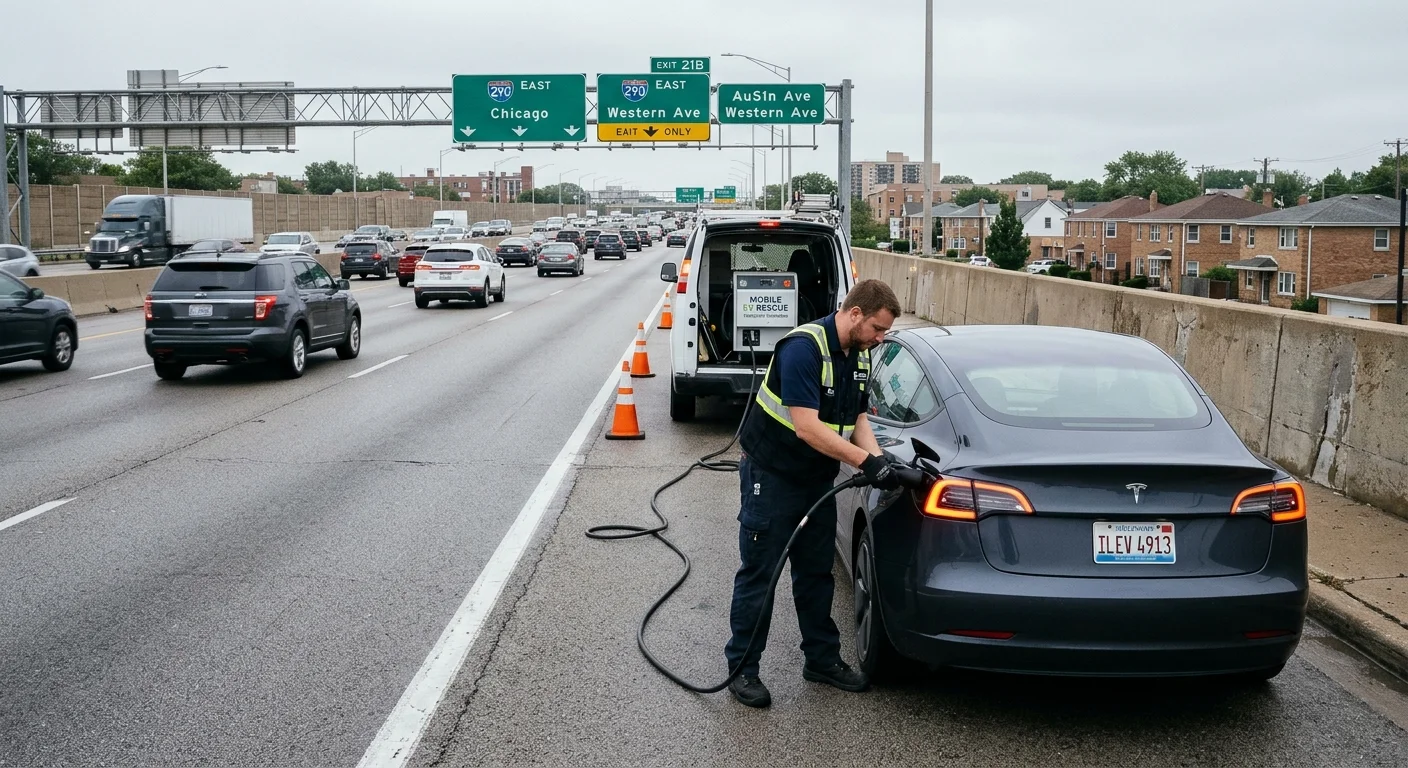
Your pack hits zero on I-290 between Austin and Harlem, and the CTA Blue Line is still running in the median while cars close on your bumper. That is not a Supercharger queue after a slow crawl west. It is an empty EV in a live IDOT expressway lane, and the first job is getting you out of traffic.
Why I-290 is a hard place to sit empty
The Eisenhower is the west-city commute spine. It runs from the Jane Byrne Interchange at the Loop, through the Illinois Medical District, Garfield Park, and Austin, then into Oak Park and Forest Park. Locals call it the Ike. On a map it is Interstate 290. The Illinois Department of Transportation maintains this stretch. It is not an Illinois Tollway road. There is no plaza, no I-PASS gantry, and no toll-road patrol as a default.
The median is the Blue Line. That is the fact that makes an empty pack here different from a stall on the Reagan or I-355. You do not have a wide grassy ditch. You have train walls, sound walls, and brick suburbs packed against the right-of-way. Eastbound you are pointed at the Loop. Westbound you are pointed at Harlem, Forest Park, and then the Hillside mix with I-88 and I-294. Either way, a stopped car in a through lane stacks traffic onto the ramps that Oak Park and Austin actually use.
Oak Park’s housing stock is old, and that shows up on this road. About 78.6 percent of Oak Park homes were built before 1980, per the U.S. Census Bureau ACS 5-Year 2019-2023. A lot of those greystones and bungalows still have no dedicated home charger. Drivers who live north of the Ike, or who cut through Austin, often start the day already thin on range. Cicero and Berwyn sit just south of this corridor. The commute pattern is city-to-suburb and suburb-to-Loop, not a farm-to-freeway run.
Cold days make the empty-pack case worse. Cabin heat, wet pavement, and stop-and-go from the Loop to Austin chew range faster than a cruise on I-88. The U.S. Department of Energy explains how temperature and accessory load cut EV range on its electric vehicles pages. None of that is a reason to sit in a live lane hoping Harlem is close enough. If the car will not roll, you need a recovery plan.
Live crash and closure news on the Eisenhower is Illinois State Police and IDOT work, not this page. If you searched “out of charge on the Eisenhower” because your car is the problem, skip the crime roundup. Treat the Ike as a high-speed IDOT freeway with a train in the middle. Charge Pro CHI is a referral service. We do not own trucks, and we do not work the shoulder. We connect you with licensed, independent local operators. They quote you. They bill you. They decide whether a boost on this corridor is even possible that hour.
Shoulder, ramp, and where you can wait
Hazards on. Get out of the travel lane if the car still moves. If you are already stopped in a through lane, stay in the vehicle if it is unsafe to stand outside, and call 911. A dead EV in a live I-290 lane is a traffic emergency first. Flashers and a seatbelt beat a hero walk along the wall.
A specific IDOT rule for stopping on the Eisenhower shoulder could not be confirmed on a public IDOT page at the time this was written. Follow the posted signs you can actually see. Do not assume a shoulder is a legal parking stall. Some stretches are narrow. Some have a barrier, a short merge, or almost no pad at all. If a state trooper or an IDOT truck tells you to move, or to wait for a wrecker, that instruction wins. We will not invent a statute or a fine.
If you still have a mile or two, the better wait is off the expressway. Harlem Avenue and Austin Boulevard are the Oak Park-adjacent exits people actually use. Forest Park has Des Plaines Avenue and 1st Avenue (Illinois 171). Toward the city you will see Central, Cicero, and then the Near West Side ramps at Western, Ashland, and beyond. A quiet lot, a legal side street, or a ramp that is clearly out of the through lanes is easier for a mobile operator than a live I-290 lane with the Blue Line at your left.
Do not walk the expressway looking for a charger. Do not pop the frunk in a travel lane to fuss with cables. Do not treat a stranger’s jumper pack as a traction-battery refill. If you can creep to a ramp and wait with flashers, do that. Tell whoever you call the direction (eastbound toward the Loop or westbound toward the suburbs) and the last exit you passed. Austin, Harlem, Des Plaines, and 1st Avenue are names operators here know. “I’m on the Eisenhower” is not a pin.
If ISP or IDOT closes a lane around you, wait for their direction. This corridor sees long shutdowns for crashes. An empty EV can become part of that scene even when you did nothing but run out of range. Your job is to be visible, out of the through lanes if you can be, and honest about whether the car will roll. An EV stranded on the Eisenhower is a lane problem until it is a charging problem.
Oak Park, Forest Park, and nearby charging
Oak Park sits on the west edge of the city proper, with I-290 cutting under Harlem and Austin. Forest Park is the next suburb west, where the Blue Line ends at the Forest Park terminal. Austin is the Chicago neighborhood on the city side of Austin Boulevard. Those three names are the local map for an Ike stall. A page that swapped in Naperville would be wrong, because this is a west-city wall, not a DuPage interchange.
We do not publish charger counts or distances to the nearest stall. Those figures are blocked on this site for a reason, and a guessed address is worse than none. Open PlugShare, Tesla’s map, or the in-car nav and confirm what is actually online before you roll. Look around Harlem, Lake Street, Madison Street, and Roosevelt Road once you are off I-290. Check the Forest Park terminal area the same way. Status changes by the hour. A stall that was working at lunch can be down at 6 p.m.
If you already crawled off the Ike and the Supercharger you aimed for is offline, that is a different job than sitting on I-290 itself. We covered that crawl-and-queue case in Supercharger down after an Eisenhower crawl. This page is for the car that did not make it off the expressway.
Oak Park has its own roadside pattern: older streets, permit parking, and alleys that do not love a flatbed. For neighborhood-level help once you are off the Ike, see EV roadside help in Oak Park. Forest Park and Austin share the same expressway wall, but the wait spots are not the same. A lot on Harlem is not a lot on Des Plaines Avenue. Tell the operator the suburb and the cross street. EV roadside assistance in Forest Park starts with a pin, not a highway nickname.
The U.S. Department of Transportation’s EV charging pages are useful background on public charging as a network. They will not tell you which Oak Park stall is up tonight. Your car’s map will. A typical mobile rescue charge is 10 to 20 miles of range in 15 to 30 minutes of Level 2 charging. That is charging time on the vehicle, not a promise about when someone arrives. Ten to twenty miles is often enough to leave I-290 and reach a working public stall you have confirmed, or to get home in Oak Park if home is closer than a public plug.
Mobile EV charging in Oak Park only helps if you are already somewhere an operator can stand. Confirm the stall. Then move. Do not rejoin the Ike at 4 percent and hope the next gap in traffic is your charger.
Dead 12V versus a pack that hit zero
These two failures feel the same from the driver’s seat. They are not the same job, and mixing them up is how people wait for the wrong truck on I-290.
A pack that hit zero is the car you were driving when the range counted down, turtle mode came on, and the motors quit. The 12-volt system may still run lights and flashers. The high-voltage battery is empty. That is out-of-charge EV recovery. A mobile operator adds energy so you can drive to a charger. A gasoline jump pack does not refill a traction battery. Neither does a 12-volt jump.
A dead 12-volt battery is the no-start that happens in a lot, or after the car has been sitting, when the screens stay dark and the high-voltage pack may still show miles in the app. Doors can act odd. The car may not go into drive even though yesterday it had 40 percent. That is a 12-volt problem. Tesla drivers can start with Tesla 12V battery jump. Other makes see the same split. Jumping or replacing the 12-volt battery is not a range boost.
On I-290 you might have both. A pack at zero can also leave 12-volt support stressed if the car sat with hazards on. Tell the operator what the last screen said. “Zero miles, I was moving, then I wasn’t” is a pack story. “Parked, then nothing, app still shows range” is a 12-volt story. If you do not know, say you do not know.
Do not keep trying to start an empty pack in a live lane. Do not assume AAA, an insurer, or a brand roadside program will send a mobile charger. Many send a flatbed. That can be the right call when you are in a travel lane and ISP wants the car gone. It is the wrong call when you are already on a Harlem or Austin ramp and 15 to 30 minutes of Level 2 would finish the trip. Ask what is actually coming before you agree. Out of charge on I-290 is a pack job. A dark screen in a Forest Park lot may not be.
When a mobile boost beats a flatbed here
A flatbed is the default for a dead EV on an expressway. Many EVs should not be towed with drive wheels on the pavement. A wrecker that can winch you onto a bed gets you off IDOT pavement fast, which is what troopers want when you are blocking I-290. The cost and the drop-off are between you and that tower. We do not publish tow prices. Chicago auto-pound and municipal tow figures could not be verified, so we will not guess them.
A mobile boost wins when three things are true. You are out of the through lanes. The operator can park and work without standing in traffic. And 10 to 20 miles of range will finish the trip to a confirmed charger or to a driveway in Oak Park or Forest Park. That is mobile EV charging as a range add, not as a full fill. The operator you are matched with quotes the work. Charge Pro CHI does not set the price and does not promise an arrival window.
On this corridor, the boost is often smarter once you have made a ramp. Harlem, Austin, Des Plaines, and 1st Avenue give an operator a place to stand that I-290 itself may not. If you are still in a through lane, a flatbed (or whatever ISP directs) is the safety move. Do not argue with a trooper so you can wait for a charger van. The Ike is not a charging stall.
If the car is a Tesla, Rivian, or another make with its own roadside program, call them too. Then call us if you want a local operator in the mix. Brand roadside and a local pro are not the same truck. We do not claim their ETAs, and we do not claim ours. The operator who takes the job tells you what they can do on an IDOT shoulder that night. Some hours a shoulder boost is possible. Some hours it is not, and a tow to a legal wait spot is the only safe path.
Once you have range, leave the Ike. Confirm the stall on the map. Drive there. Plug in. The Eisenhower will still be the Eisenhower tomorrow. The only goal tonight is to get an empty pack out of IDOT pavement and onto a cord you have verified.
When to call us
Call when the pack is empty on I-290, or you are on an Oak Park or Forest Park ramp and cannot reach a working charger on what is left. Call when you need a local operator for a range boost instead of guessing at a tow. Call us at (708) 412-5005 and we’ll connect you with a local EV rescue operator.